It is late. The video ends. The presenter is up forty units, the comments are full of people saying they will try it tomorrow, and you are thinking the same thing.
Here is what "trying it tomorrow" has always meant: a live table, real chips, and a strategy you are carrying in your head, half remembered, with no idea what it does on a bad night because the video only ever shows a good one.
Here is what it means from today.
The VIPER AI Wizard is out. You describe a strategy in plain English, and within minutes you have a real, working strategy — one you can adjust, test on thousands of spins, and play at a live table, with VIPER reading the spins and placing the chips if you want it to.
To show you, we took one system from idea to live table, start to finish. Every screenshot below is from the real app.
Step 1: Write down what you saw
YouTube is full of "sleeping dozen" systems, so we wrote one up. We called it the Sleeping Dozen Ladder. When one dozen has not come up for six spins in a row, bet it. If it misses, climb a 1-1-2-3-5-8-13 ladder. When it hits, go back to the start and wait for the next sleeper.
That is all you need to know to describe it, and that is all we typed.
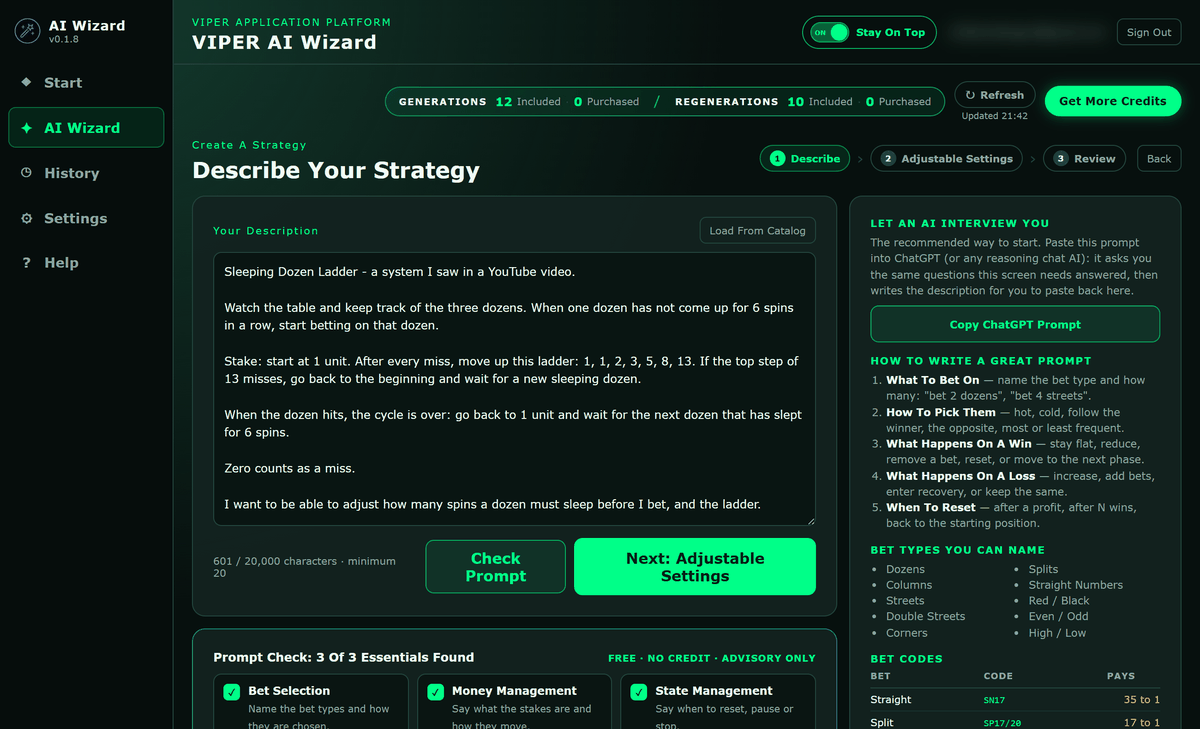
Press Check Prompt and the app tells you, free and instantly, whether you have covered the three things every strategy needs: what to bet, how the stakes move, and when to reset. Ours scored 3 of 3.
The trick for YouTube systems is the button on the right: Copy ChatGPT Prompt. Paste it into ChatGPT (or any reasoning chat AI you already use), tell it about the video, and it interviews you. It asks a few questions at a time and offers concrete choices when you are unsure. Crucially, it asks the questions the video never answered. What happens on zero? When does the ladder reset? What if the top step misses? Videos skip those, and they are exactly the rules that decide what a system does on a bad night. When it has everything, it prints a finished description for you to paste back.
Step 2: Generate it in 32 seconds
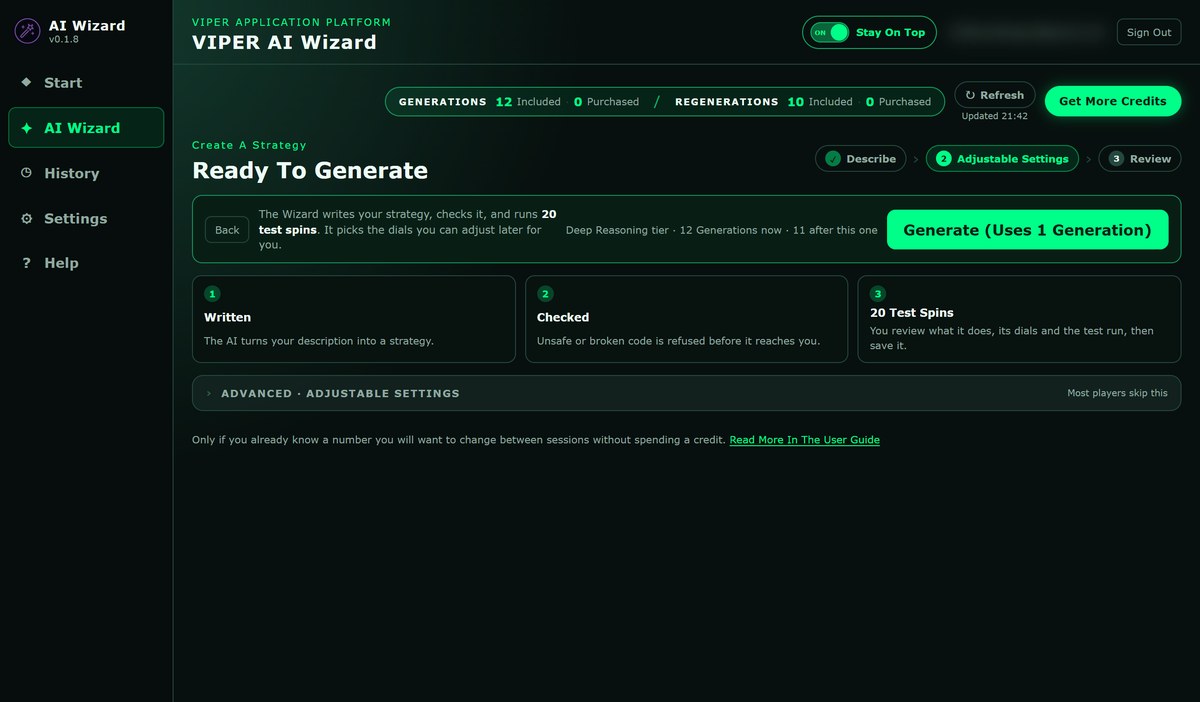
One button. The Wizard writes the strategy, checks it (unsafe or broken code is refused before it reaches you), and runs it through 20 test spins. It even picks which settings you will be able to adjust later.
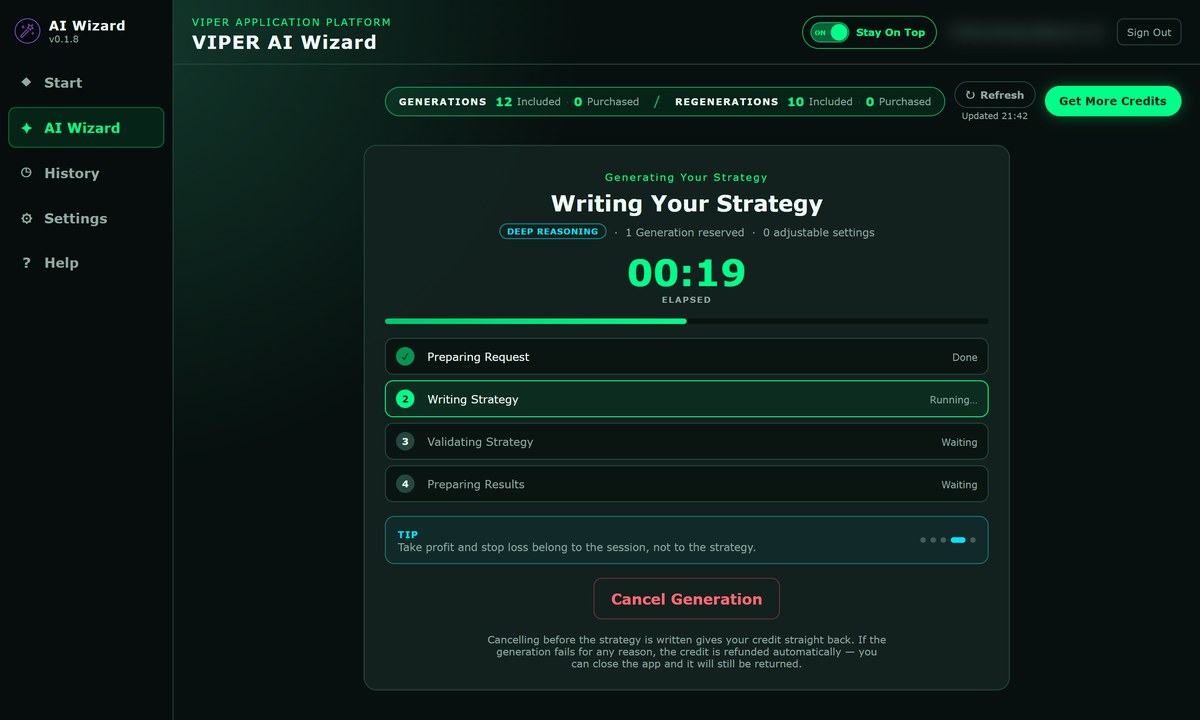
Ours was done in 32 seconds.
Step 3: Check it did what you asked
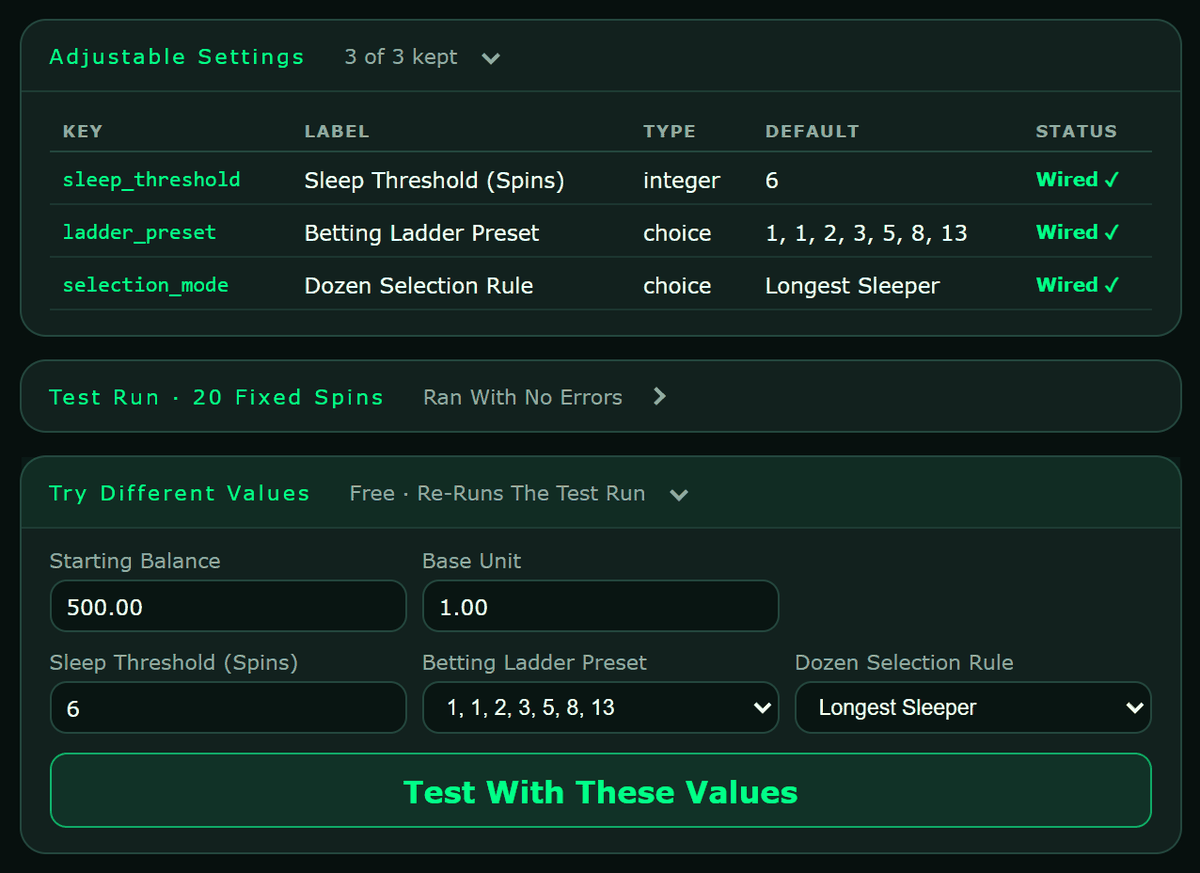
The Review screen explains, in plain sentences, what the strategy does, so you can hold it up against what you asked for. Then it shows the dials it built in. Ours came back with three: the sleep threshold (6 spins), a ladder preset with five ladders to choose from, and a dozen selection rule for when two dozens go quiet at once. We had only asked for the first two.
Every dial is marked Wired, which means VIPER read the generated code and proved the strategy genuinely uses it. A setting the code ignores never reaches you, because a dial that looks live but is not will eventually show you one number while the strategy plays another.
Not what you meant? Refine It, say what to change, and it writes a new version. Happy? Save Strategy, and it is in your session list at once. No restart.
Step 4: Find out what the video did not show you
This is the step that used to be impossible, and it is the one that matters.
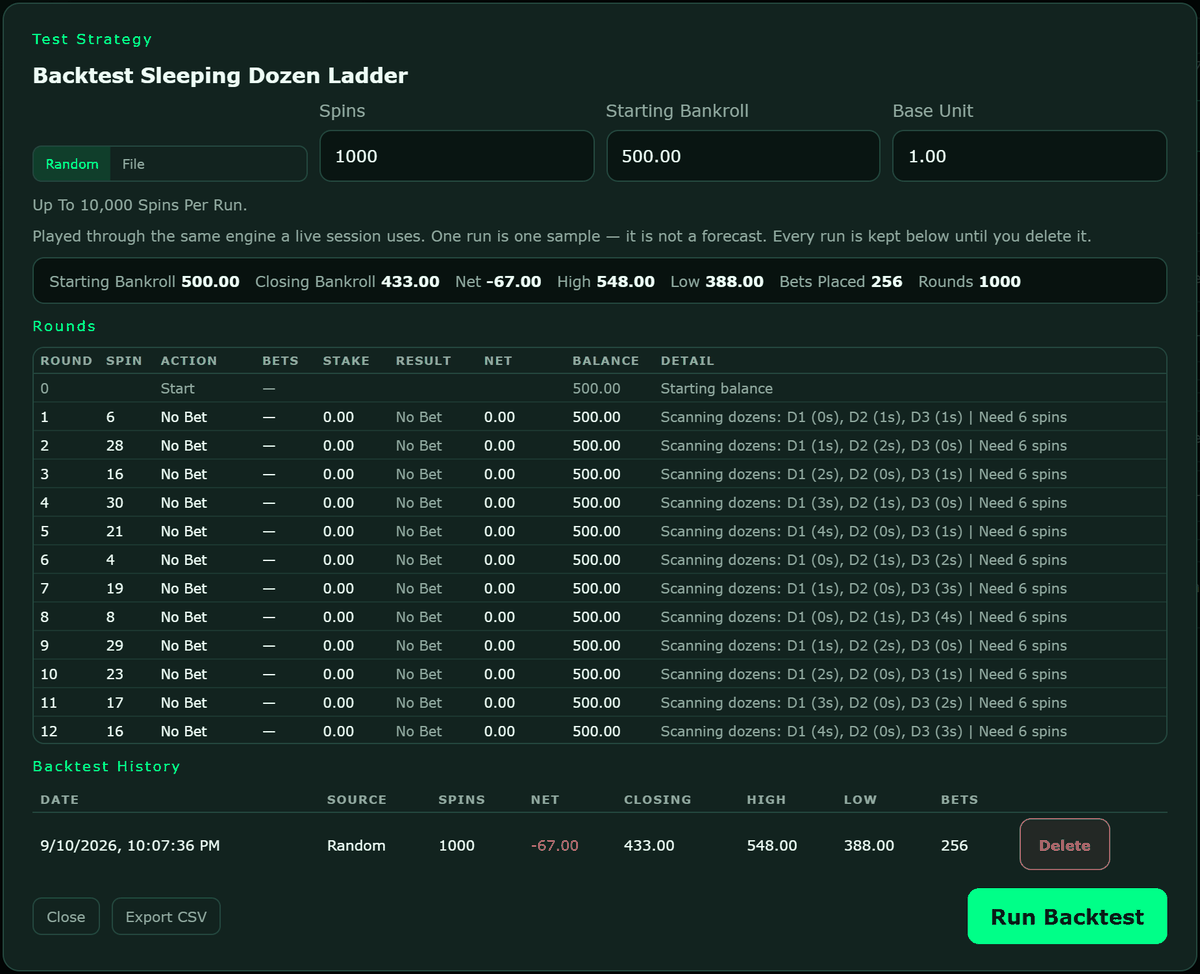
We gave the Sleeping Dozen Ladder 1,000 random spins, a $500 bankroll and a $1 unit. It placed 256 bets, climbed as high as $548, dropped as low as $388, and finished at $433.
The detail is more interesting than the total. Across the run the strategy started 92 ladders. 85 of them hit somewhere on the way up and closed a unit or a few ahead — that is the video, over and over. 7 of them ran all the way to the top and missed, and each of those cost 1 + 1 + 2 + 3 + 5 + 8 + 13 = 33 units in one go.
That is the shape of almost every ladder system on YouTube: a long string of small wins, and now and then one heavy loss. The video shows you the string. The backtest shows you both, before a single chip of yours is on the table. One run is one sample, not a forecast — run it again, run it on 10,000 spins or on a spin file of your own, and read it the way this checklist describes.
Step 5: Take it to the table
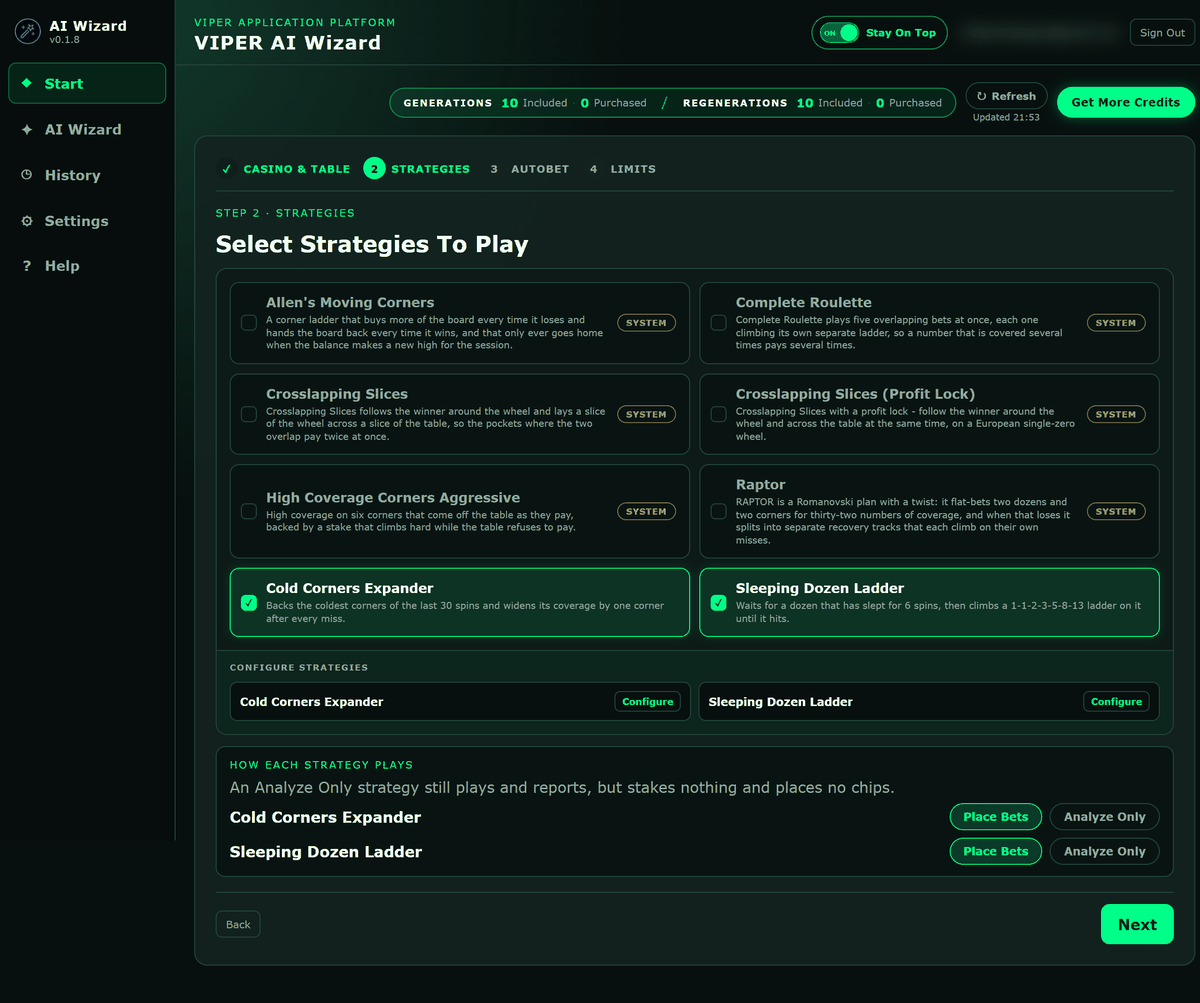
Begin Session takes four short steps: your table and bankroll, your strategies, whether VIPER places the chips, and your limits. Our new strategy was already in the list. We ran it alongside Cold Corners Expander, which we generated from the built-in catalog.
Any strategy can be set to Analyze Only. It plays and reports every round at the real table, but it stakes nothing and places no chips. For a system you only met last night, that is the perfect first session.
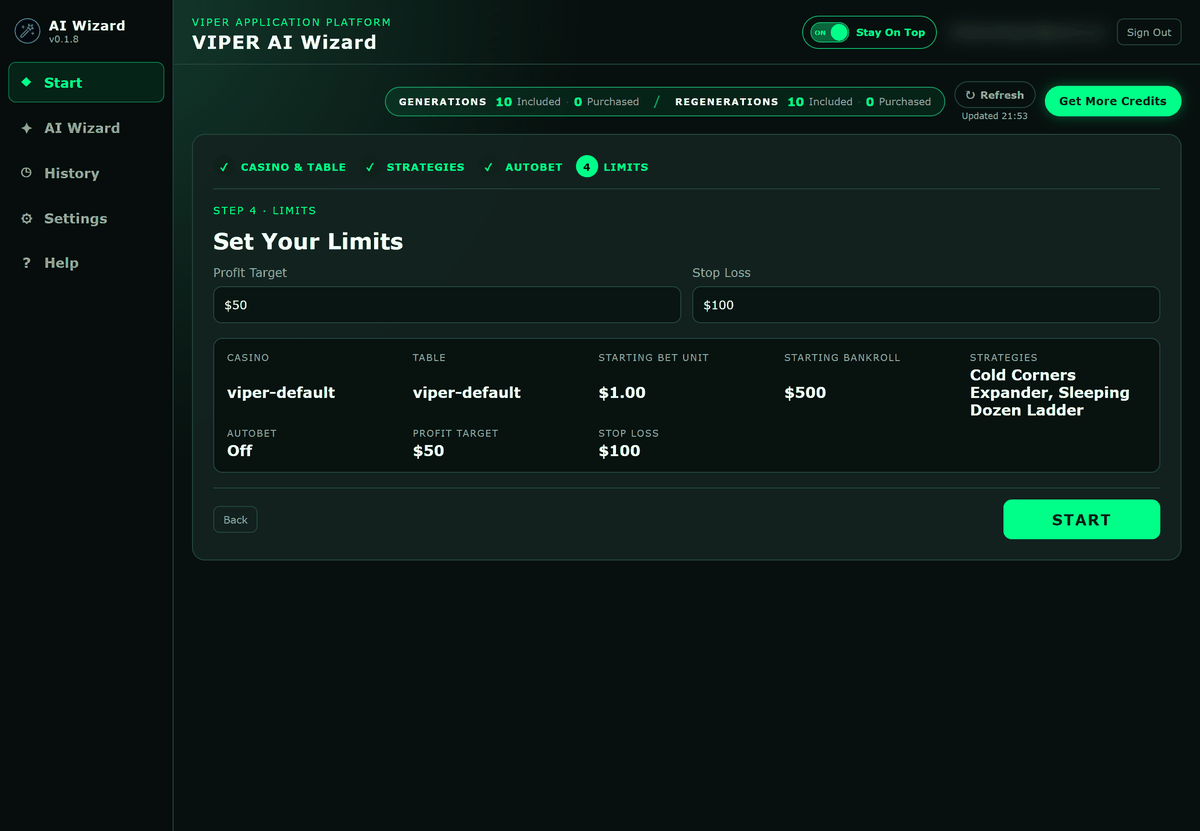
Then the limits: a profit target and a stop loss. We set $50 and $100.
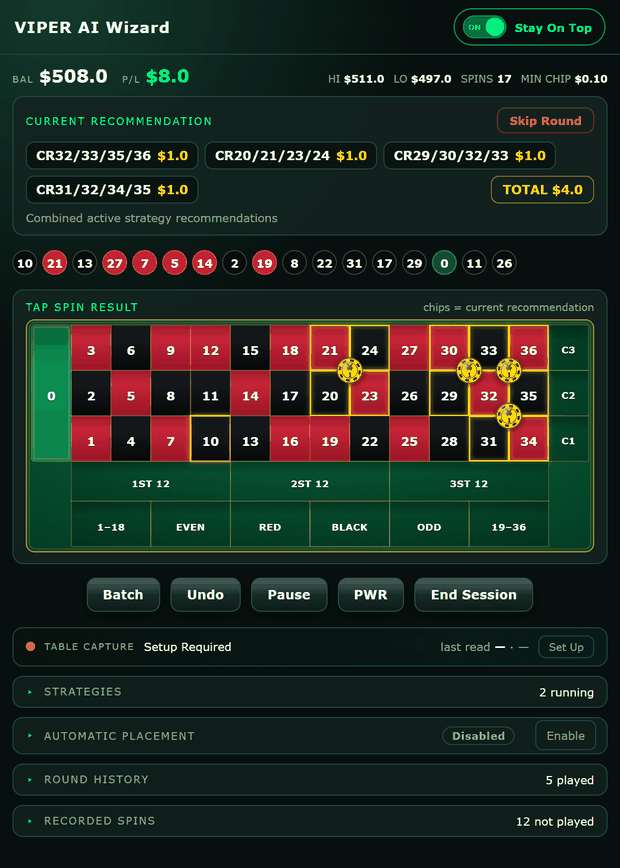
Press START and VIPER shrinks to a compact window that sits beside the casino. Before each spin it tells you exactly what to bet and draws the chips on the board. Tap the number that came in, and the next bet appears. Each strategy's P/L INFO window charts how it is doing, round by round.
Step 6: Take your hands off
Now the part the video could never give you.
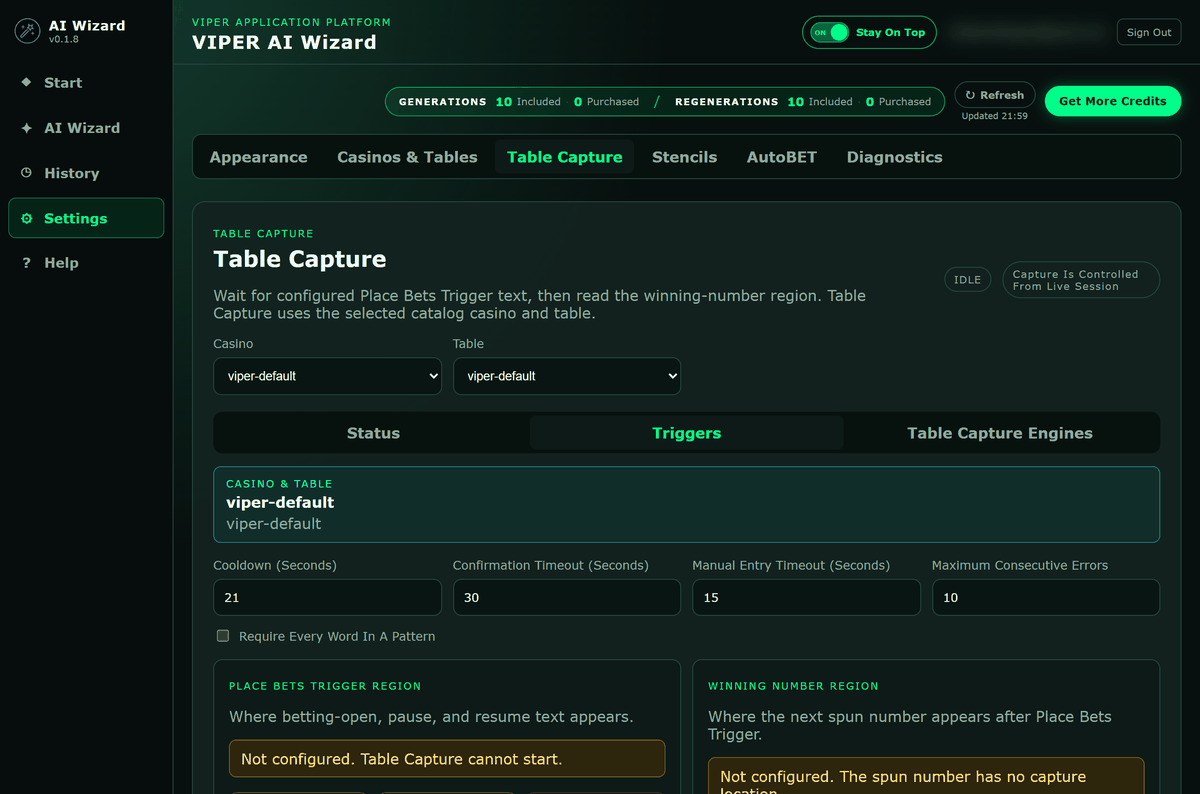
Switch on Table Capture and VIPER reads each winning number straight off the casino window on your screen, waits for the table's place-your-bets message, and asks you to confirm any number it is unsure of. Switch on AutoBET and it places each recommendation on the table with real mouse clicks, from a stencil of your table that a capture wizard helps you make once.
With both running, VIPER reads the spin, works out the next step of the ladder, and places it. The system from the video is playing itself.
Step 7: Let it stop you
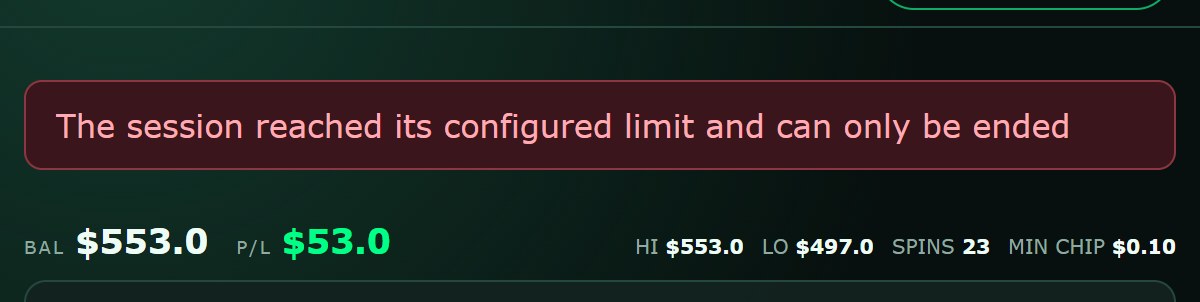
In our demo session the balance crossed the $50 target, and VIPER stopped dead: the session reached its configured limit and can only be ended.
This is the step nobody makes a video about, and it is the one that decides most nights. The strategy matters less than you think. How much you stake against your bankroll, how long you stay, and whether you leave while you are ahead matter more than you think. The presenter who is up forty units at the end of the video is showing you a good stop as much as a good system. VIPER makes that stop automatic, so it still holds at the moment your willpower would not. More on that in automating discipline.
Before you press play
Three honest things.
The Wizard builds what you describe. It does not make the idea good. A faithful copy of a bad system is a bad system, and the backtest is how you tell the difference.
The wheel does not know a dozen has been sleeping. The trigger decides when you bet, never the odds: a dozen still misses 25 times in 37 on a single-zero wheel, so seven misses in a row comes along about once every sixteen ladders. In our run it was 7 in 92. Size your unit so a 33-unit loss is survivable — here is how.
And every strategy, yours or ours, plays against the same 2.70% house edge. Over a short session that edge is small next to the swings, and the swings are what VIPER is built to manage.
No video? Start with ours
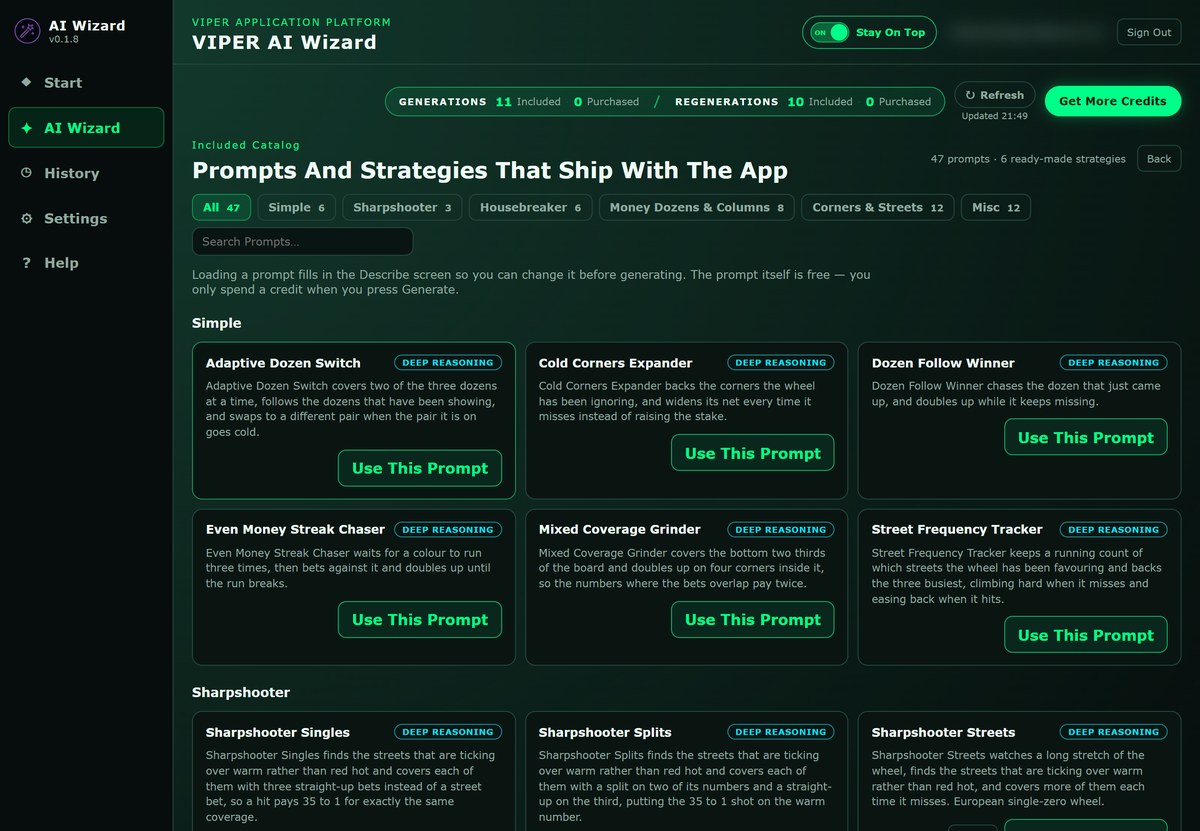
The app ships with 47 ready-written strategy descriptions in six families — Simple, Sharpshooter, Housebreaker, Money Dozens & Columns, Corners & Streets, and Misc — that you can load for free, change however you like, and generate as your own. Six more are already built and ready to play without spending a credit.
The VIPER AI Wizard is a Windows desktop app, included with VIPER Monthly and VIPER Yearly (20 generations and 10 regenerations every month) and with Day Credits (3 and 5 per credit, never expiring). You can also subscribe to the Wizard on its own for $24.99 a month, with the same 20 generations and 10 regenerations. See the plans.
Then go and find that video again. This time, find out what it actually does.
— Team Viper