Everyone who has spent real time at a table has one. An idea. Something you noticed, or something you saw someone else do, or a rule you have half worked out on the back of a receipt.
And it stays a hunch, because the gap between "I wonder if..." and something you can actually test has always been enormous. You would need to specify it exactly, code it, debug it, and run it over enough spins to mean anything. So instead the idea gets tried on a live table for two hours on a Friday, which teaches you nothing, and then it gets forgotten.
The AI Wizard exists to close that gap. Describe the idea in plain English and it builds a working strategy — one that runs in VIPER like any other, with settings you can tune, and which you can immediately backtest.
But the part we want to talk about is what happens before you describe it. Because the hardest part of this was never the code.
The problem is that you know more than you can say
Ask anyone to describe their strategy and you get something like: "I wait for a couple of cold dozens, then I bet the other one and press it up if it misses."
That is a real idea. It is also full of holes. A couple — is that two or three? Cold over what window? Press up by how much, and how far? What happens when it hits? When do you start again? What if it misses six times?
You know the answers. You have played it. You just have never had to say them out loud in order, and nobody has ever asked.
So we made something that asks.
Let an AI interview you: questions, not a form
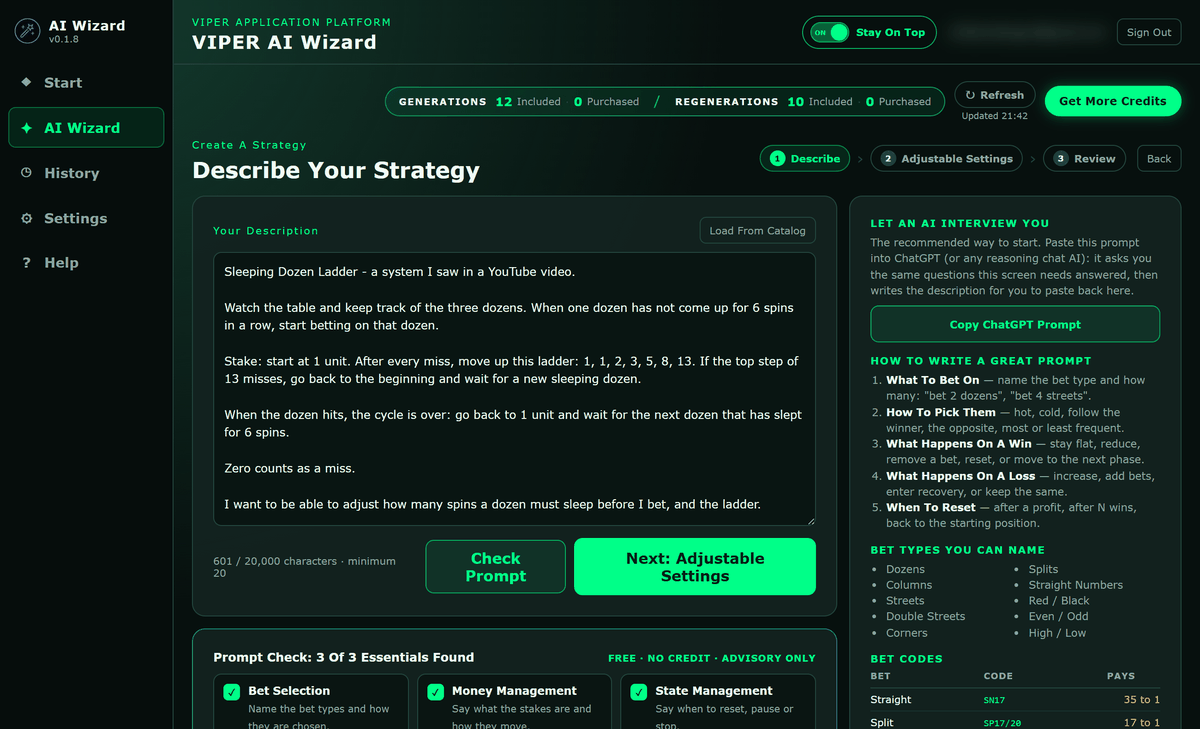
On the Describe screen there is a button marked Copy ChatGPT Prompt. It puts a prompt on your clipboard. You paste that into ChatGPT, or any reasoning chat AI you already use, and it stops being a chatbot and becomes an interviewer working for you.
It has rules. It asks at most four questions per round and then waits for your answers before going on. It uses plain language, never code or formulas. If you are vague it does not shrug and guess — it offers you two or three concrete choices and lets you pick. And it keeps going until it can state every rule of your strategy without guessing at any of them.
It works through seven things, in this order:
- The idea in one sentence, and a name for it.
- Bets. Which types — straight numbers, splits, streets, corners, double streets, dozens, columns, red/black, odd/even, high/low — how many per spin, and how they get chosen: fixed, following recent winners, avoiding them, coldest, hottest, or a pattern.
- Stakes. The starting stake, and what happens after a win and after a loss. Flat, step up on wins, step up on losses, or a written-out ladder like 1-2-3-5-8. Any cap, and what happens when you reach it.
- When to start. From the first spin, after watching a number of spins, or on a trigger.
- When to stop or pause. Stop-loss, profit target, lock in profit once ahead, sit out after a run of losses — or none at all, since VIPER has its own.
- Resets. When does the whole thing go back to the beginning?
- What you want to adjust later. Which numbers should become dials you can turn in the app.
At the end it hands you a clean block of plain English to paste straight into the Wizard's Describe box.
Notice what that list is. It is every question that makes a vague idea into a testable one — and it is exactly the set of questions that never get asked when a strategy is tried out live with real money instead. Most ideas do not fail because they were bad. They fail because they were never finished.
The interview is worth doing even if you never generate anything. Several of our own strategies changed shape during it, when a question exposed a rule we had not actually decided.
Then it gets built properly
Paste the description in and the Wizard writes the strategy. A few things happen there that are worth knowing about, because they are the difference between a generated strategy and a trustworthy one.
The dials are verified, not taken on trust. You declare what you want to be adjustable. The model reports what it exposed. And then VIPER reads the generated code itself and checks that each setting is genuinely wired to something the strategy actually uses. Anything that is not read by the code gets dropped rather than displayed — because a setting that looks live but is not will eventually show you one number while the strategy plays another. That is the kind of bug that quietly ruins a month of results, and we would rather show you fewer dials than one that lies.
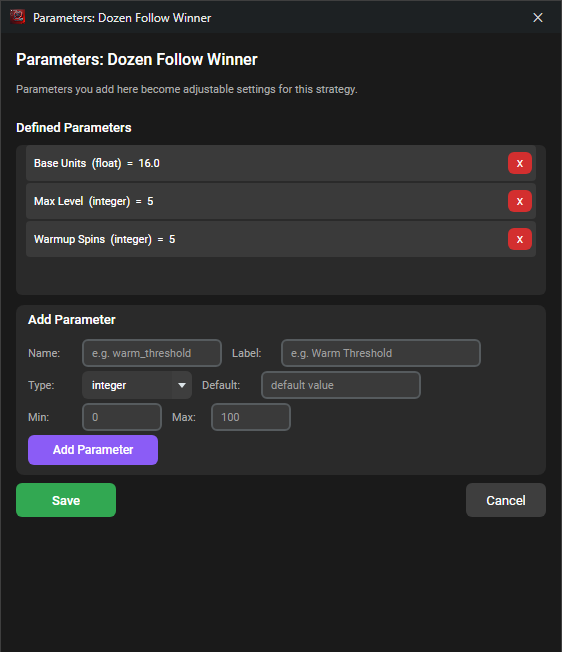
Ladders get Dynamic Play automatically. If your idea has a ladder, a level or a cycle in it, the Wizard builds the Dynamic Play controls in as part of the job. Your own strategy arrives with the same step-up, step-down and re-aim controls as anything else in the platform.
It speaks the bet codes. You can be as precise as you like in the description — D2 for the second dozen, CR1/2/4/5 for that corner, DS3 for the double street covering 7 to 12 — or you can write it in words and let it work them out.
The loop is the point
Here is where this stops being a novelty and starts being useful.
One generated strategy is interesting. What changes how you work is that the cost of trying an idea drops to almost nothing, and so you stop having ideas one at a time.
describe  ->  generate  ->  backtest  ->  read the numbers
    ^                                          |
    |                                          v
 adjust the dials  <-  or regenerate with a changed rule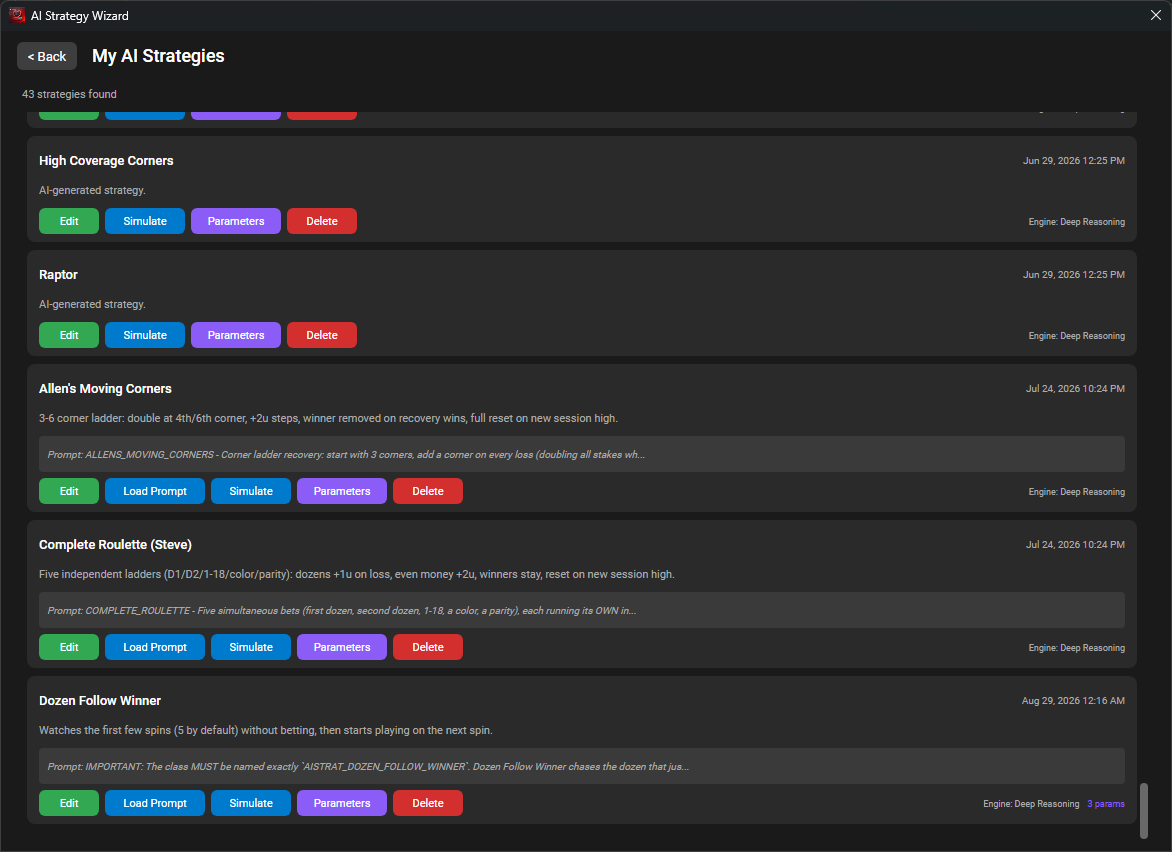
Backtest it against the free million-spin dataset. Look at the drawdown and the losing runs, not the win rate — that article is the checklist. Then turn a dial and run it again. Or change a rule in the description and regenerate, which the Wizard treats as its own kind of request specifically so you can iterate on an existing strategy rather than starting over.
A cycle that used to take a week of coding, or a season of expensive Friday nights, now takes a few minutes. That is not a small convenience. It changes which ideas are worth having at all — because when testing is nearly free, the honest answer to "would that work?" stops being a debate and starts being a result.
And a great many of your ideas will not survive that loop. Good. That is the entire point, and it is far cheaper to find out on a laptop than across three sessions and a bankroll. The ones that do survive, you will know something real about before you ever play them.
What it is not
It is not a promise about any one night. Every strategy the Wizard builds rides the same short-term swings as everything else on the table, which is why it sits one click from a backtest before you play, and inside VIPER's session limits while you do.
What it is: the shortest path we know of from something you noticed at a table to something you can put real numbers against. Your experience is the input. The maths is the referee.
Bring the idea you have been carrying around. Let's find out what it actually does.
— Team Viper