Here is a moment every one of us knows.
Your strategy has done its job. It has watched the spins, applied its rules, and it is telling you to put four units on the second dozen. And you have been sitting at this table for forty minutes, you have watched something the rule set was never written to notice, and everything in you is saying not this one.
Until now you had two options, and both were bad. Obey a rule set that cannot see what you can see. Or switch the thing off and start improvising with real money, which is exactly how disciplined sessions turn into bad ones.
Dynamic Play is the third option.
The window between the recommendation and the chips
When a Dynamic Play strategy has bets for the round, VIPER does not place them immediately. It holds them, and opens a review window — fifteen seconds by default, and you can set it to whatever suits your table.
In that window the bets sit on screen with the ladder position they came from, and you decide.
- Step the progression up. One level, deliberately.
- Step it down. Back off without abandoning the plan.
- Re-aim it. Point the same stake at a different dozen, column or even-money bet, where the strategy has a single target to move.
- Skip the round. Sit this one out entirely. The held bets are dropped cleanly — no settlement, no movement of the ladder — and the strategy carries on next round exactly where it was.
- Do nothing. The original bets place themselves and the round proceeds exactly as the strategy intended.
Every button you press restarts the window, so you are never rushed into a half-made decision by a clock you did not set.
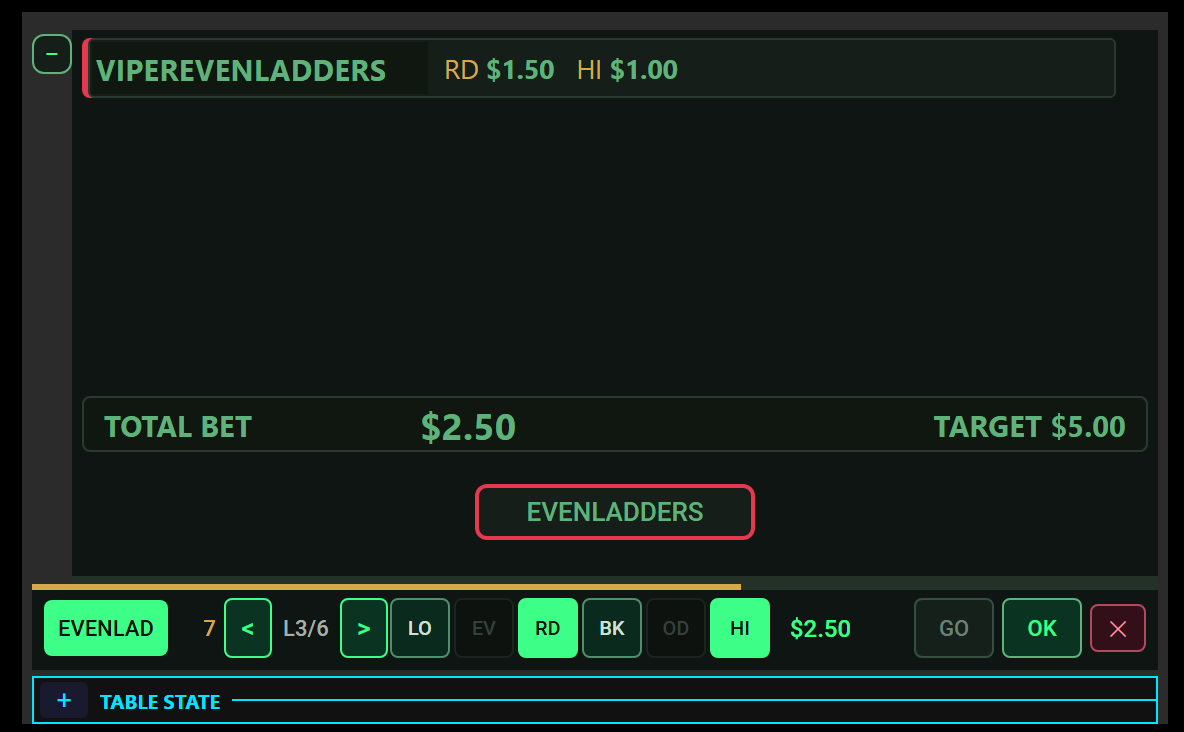
Here is a hold in progress. The strategy has two arms running — colour aimed at red, range aimed at high — and it is sitting on level three of a six-rung ladder, so both steppers are live. Seven seconds left on the clock, and the bets are waiting.
Now the same hold, one keypress later, after a single press of the step-down control:
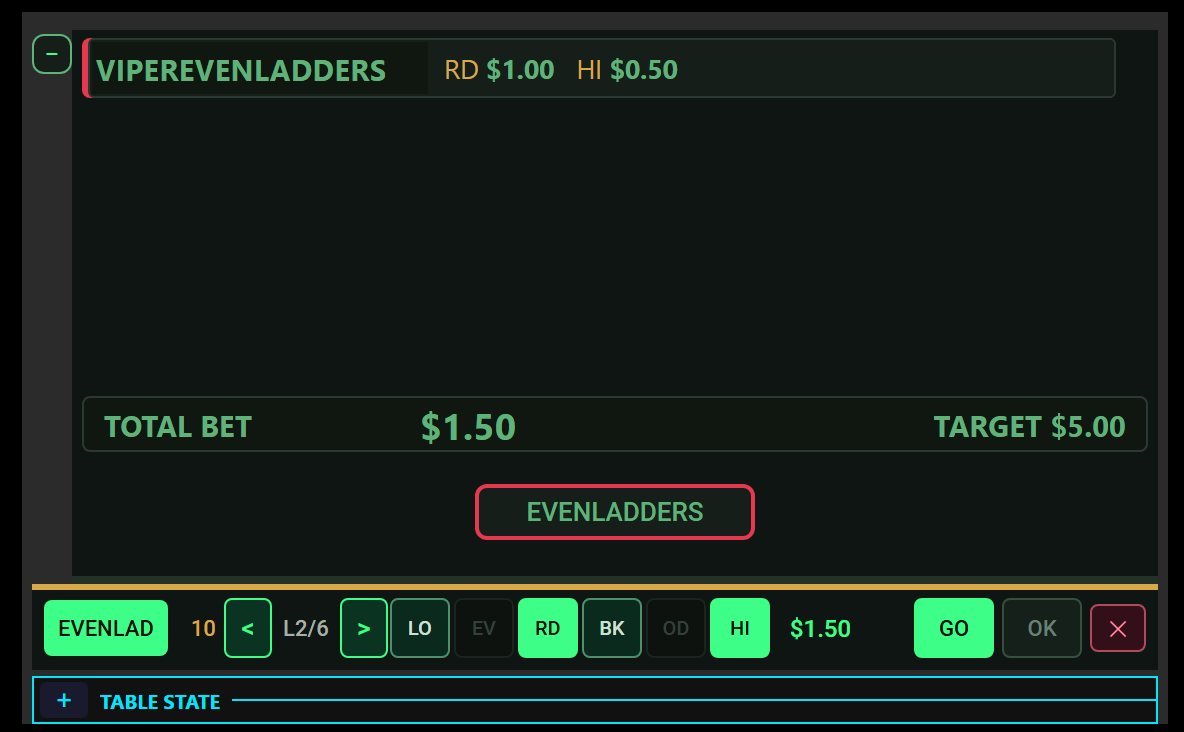
Look at what changed and what did not. Both arms stepped together, the stakes were recalculated rather than merely relabelled, the total updated, and the clock went back to full because you interacted with it. The strategy itself is untouched: it is still the same strategy, on the same ladder, one rung lower than it proposed.
What it does not do
We are going to be straight about this: Dynamic Play does not change what the game costs you. Stepping a ladder up or down does not make a bet better than 2.70% against you, and nothing does. What it changes is your exposure and your timing — which, as the short session sets out, is where almost all of your real control lives anyway.
That article sets out the three things that genuinely decide how a night goes. Dynamic Play is a control surface for every one of them:
| What actually decides your night | What Dynamic Play hands you |
|---|---|
| How much you have on the table | Step the ladder down, or up, one deliberate level |
| How long you stay exposed | Skip the round and sit it out entirely |
| Whether you leave while you are up | A deliberate moment, every round, to decide |
That last one is quietly the most valuable. Dynamic Play puts a small, regular pause between the recommendation and the money — and a pause is the single thing most missing from a session that has started to go wrong.
The part that makes it safe to use
A control that lets you reach into a running strategy could easily corrupt it. This is the engineering we are most pleased with, and it is worth understanding, because it is what lets you use the feature without hesitating.
Your adjustment is not a result. A step you take replaces this round's recommendation. It is not recorded as a win or a loss, and the strategy's own progression rules still apply to whatever the next spin does. You are moving the strategy's starting point for this round, not lying to it about what happened.
Everything is snapshotted first. Before the hold opens, VIPER takes a complete copy of every piece of state your adjustment could touch — including the pending-bet bookkeeping. Any change can be rolled back exactly, not approximately.
The bets place themselves if you do not act. Hesitation costs you nothing. If the window expires the original bets go down as intended. And if the table is about to spin, placement happens anyway with five seconds to spare — a rule the betting session owns itself, so it holds whether or not the Dynamic Play bar is on screen. Nothing about your money depends on a widget being visible.
A held round that never gets placed is voided, not guessed at. If you skip the round, pause the session, or the wheel simply spins before you have decided, those bets are dropped with no settlement and no movement of the ladder. The strategy is never left holding a bet that cannot be resolved, and it never records a result for money that never went down.
Which strategies have it
Dynamic Play needs something to step, so it appears on strategies built around a ladder, a level, a step or a cycle. A genuinely flat strategy has nothing to adjust and does not offer it — and we would rather show you nothing than show you a stepper that does not do anything.
It is a strict all-or-nothing contract internally: a strategy implements the full set of Dynamic Play operations or none of them. There is no half-supported state where one button works and another quietly does not.
You choose which of your strategies run with it. Tick the ones where your judgement genuinely adds something and leave the rest to run their rules untouched — which is often the right answer.
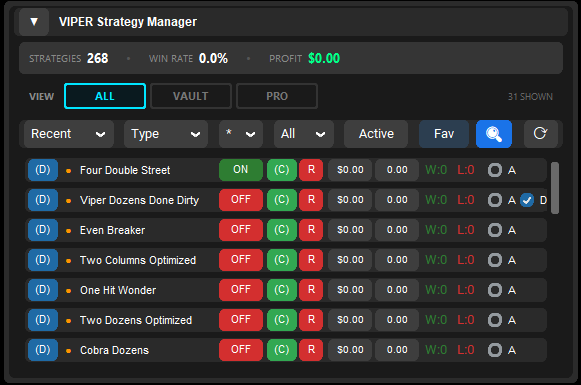
And when the AI Wizard writes a strategy for you that has a ladder in it, Dynamic Play is generated as part of the build. Your own idea arrives with the same controls as everything else.
Using it well, and the honest warning
Here is the thing we are not going to skip past. The same control that lets you step down to protect a session lets you step up to chase one.
Our opening post named chasing as the single biggest destroyer of bankrolls, above the house edge and above bad strategy selection. We are not now going to hand you an escalate button and pretend the risk vanished because the interface is nice.
So, plainly:
- Step down freely. Step up rarely. Backing off is almost always the judgement worth trusting. Escalating is almost always the tilt talking.
- Decide your rule before the session, not in the window. "I step down after three losses in a row" is judgement. "I am stepping up because I am owed one" is the bet that is "due" with a button attached.
- If you are reaching for step-up to get even, stop. That is the exact moment the feature is being used against you, by you. Your stop-loss exists for that moment; let it work.
- Doing nothing is a legitimate use. Most rounds should pass untouched. If you are adjusting every round, you are not applying judgement, you are fidgeting — and your backtest no longer describes what you are playing.
That last point matters more than it looks. Every adjustment you make is a small departure from the strategy you tested. A handful of deliberate departures across a session is judgement. A hundred of them is a different, untested strategy that you are inventing at the table.
Both, brought to bear
A rule set is disciplined but blind. A player is perceptive but, in the wrong moment, undisciplined. Every platform we know of makes you pick one.
Dynamic Play is our attempt to take the useful half of each: the strategy holds the line and does the counting, and you get a deliberate, bounded, fully reversible say in the seconds before the chips go down. The rules keep you honest. You keep the rules informed.
That is a fairer fight than either of you gets alone.
— Team Viper