There's a question every baccarat player should be able to answer before the first card is dealt, and almost nobody can: what number gets you up from the table?
Not "when I'm ahead." Not "when it feels right." A number. Because the house has one, and it's working against you on every single hand.
Only gamble with money you can afford to lose.
The house doesn't need a hot shoe. It needs you to stay.
Baccarat is the fairest table in the casino, and that's exactly the trap. A Banker bet costs you 1.06% of what you stake, on average, hand after hand. Player costs 1.24%. Tie, 14.36%. Those prices never change. No pattern on the roads changes them, no streak changes them, no progression changes them.
That 1.06% sounds like nothing, and on one hand it is. But it's charged per hand. A player who bets one unit on Banker for a full 120-hand session has staked 119 units and paid the house roughly 1.3 of them for the privilege. A player who plays five hands and leaves has paid a fraction of that.
Here's the part the casino would rather you didn't think about: the house edge is a toll on volume. You can't lower the toll, but you decide how many times you pay it. Every hand you don't play is a hand the house doesn't collect on.
So the first rule of a plan isn't a betting system. It's an exit.
Why leaving early works, in one example
Say you sit down with 20 units and want to double them.
Grind it one unit at a time on Banker and you'll reach 40 before you reach 0 about 37 times in 100. Put the whole 20 on Banker in one bet and you'll be sitting on 39 (the commission keeps the other unit) about 51 times in 100. Same bankroll, same side, same idea. Fourteen points of difference, and not one of them came from reading the shoe. They came from giving the toll fewer hands to collect.
That's not a trick. It's a theorem. When the price of a bet is against you, the way to maximise your chance of reaching a target is to get there in as few bets as possible. Mathematicians call it bold play, and they proved it in the 1960s.
The catch is that nobody can actually do it at a table. A real table has a maximum bet, you have a bankroll you'd like to keep, and "shove it all in" isn't a plan anyone can live with. What you want is bold play's result with a human's limits.
That's what Abacus is.
Abacus: a target, a stop, and the right bet for every hand in between
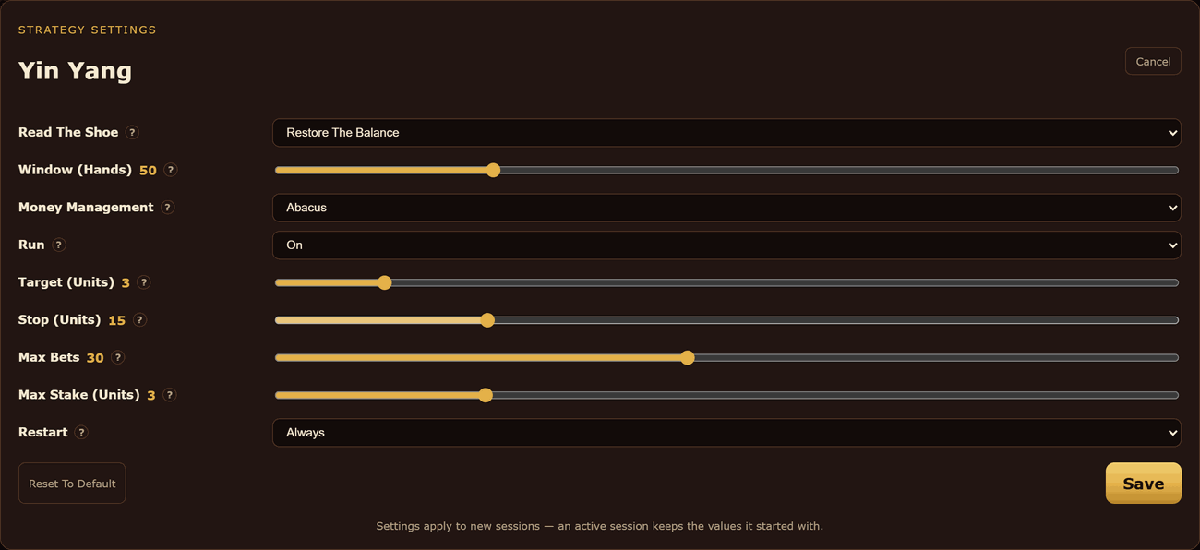
Abacus is one of the Money Management modes every Classic strategy in BaccaratNEURAL can run. It's the one built around a goal.
You give it four numbers:
- Target (Units): the profit that ends the run.
- Stop (Units): the most the run may lose. Abacus never sizes a bet past it.
- Max Bets: how many bets the run gets.
- Max Stake (Units): the biggest single bet you'll allow.
Then, before every hand, it works out the exact stake that gives this run the best possible chance of reaching its Target before it hits the Stop, from exactly where the run stands right now. Behind a loss, that bet may grow. Close to the Target, it shrinks to the one unit that gets you there. It's the mathematics of planning the best next move given everything that has already happened, done for you on every hand.
Set Restart to Off and Abacus plays one run and stops. Target reached, run over. Stop or Max Bets reached, run over. Either way, Abacus places nothing more. That's your exit, decided before hand one.
We introduced Abacus alongside its three stablemates in Four ways to stake your baccarat bankroll. Chained run after run for a full session, its default settings make for a bold night. Played as one run and done, the same settings become the plan below.
Follow The Banker: the cheapest seat at the table
Abacus decides how much. The strategy decides which side. For a plan built on paying the house as little as possible, there's one natural choice: Follow The Banker. Banker is the lowest-priced bet in the game, and the strategy backs it every hand, nothing else, no reading of the shoe required.
There's a second reason this pairing is special, for the people who like to know their tools. Abacus plans its run assuming the run stays on one side. On a strategy that switches between Player and Banker, that plan is an approximation. On Follow The Banker, which never switches, it's exact. The maths behind every bet is the maths of the table in front of you, with nothing rounded off.
What it looks like, measured
We don't publish numbers we haven't played. The row below is Follow The Banker running Abacus at its default run (Target 1, Stop 50, Max Bets 30, Max Stake 5) as one run per session, dealt card by card from eight-deck shoes with the full third-card rules and the 5% commission, 5,000 sessions, on a 100-unit bankroll. Beside it, the same strategy betting one unit flat for a full 120-hand session, on the same shoes.
| Follow The Banker | Best | Typical | Worst | Ahead /100 | Busted /100 | Hands played |
|---|---|---|---|---|---|---|
| Abacus, one run and leave | +1.9 | +1.9 | −50.0 | 93.6 | 0.0 | about 5 |
| Still Water, one unit, full session | +36.5 | −1.6 | −39.9 | 45.7 | 0.0 | 119 |
Units of your Starting Bet Unit. Typical is the middle session: half did better, half did worse.
Read it the way the plan was designed to be read:
- The run gets its number 93.6 times in 100. The typical session banks +1.9 units and is over in about five hands. You walked in with a number, you got it, you left. (Abacus opens with two units, so one Banker win puts you +1.9.)
- You paid about a fifth of the toll. On average, the one-run session cost about a fifth of what the full flat session did. Five hands against 119 will do that.
- The other 6 in 100 never cost more than you allowed. Most of those runs simply used up their 30 bets short of the Target and ended there, short of the Stop. In 5,000 sessions, not one lost more than the 50 units you said it could. That's the whole trade in one line: a small, likely win and a ceiling on the rare loss, both chosen before you sat down, and Abacus never took either decision away from you.
Want a bigger number than one unit? Raise the Target and Abacus re-plans every bet around it. Want the ceiling lower? Drop the Stop. The point isn't these particular four numbers. The point is that they're yours, they're set before the first card, and the exit is built in.
The plan, start to finish
- Decide your number before you open the app. Target and Stop, in units. Say them out loud if you have to.
- Begin Session, Step 2: pick Follow The Banker, press Configure, and set Money Management to Abacus.
- Enter your Target, Stop, Max Bets and Max Stake. Set Restart to Off.
- Play. Abacus sizes every bet. When the run ends, it stops betting, and so do you.
- Get up. The toll stops the moment you do.
The house edge is patient. It makes its money from players who sit down without a number and stay until the shoe decides for them. Walk in with a target, a stop and the bet sized right for every hand between them, and you've taken the one decision in baccarat that was ever really yours.
Get BaccaratNEURAL. Follow The Banker and Abacus are included with every Classic.
— Team Viper