Ask ten baccarat players what wins sessions and you'll hear ten answers about the shoe. Follow the Banker. Follow the streak. Bet the chop. But the players who last know a quieter truth: which side you back is only half the game. How much you bet, hand after hand, is the other half.
That's money management, and it's where a session's character is really decided. Same shoe, same picks, two different staking plans, and you can walk away with two completely different nights.
BaccaratNEURAL gives every Classic strategy four money management modes to choose from. Follow The Banker, Follow The Shoe and Chop pick the side. You pick how they bet it. This post walks through all four: how each one works, what it's great at, where it bites, and the measured numbers behind it.
Only gamble with money you can afford to lose.
Selection and staking: two separate dials
Every BaccaratNEURAL strategy is built from two parts:
- The selection decides which side to back, Player or Banker, or whether to sit a hand out.
- The Money Management decides how many units that bet stakes.
Because the two are separate, any Classic can run any mode. Follow The Banker on a recovery ladder, Chop with a press-on-wins progression, Follow The Shoe flat: every combination is one dropdown away. You'll find it at Begin Session, Step 2: pick your strategy, press Configure, and choose under Money Management. (Yin Yang has exactly the same choice; it just starts on a different one.)
How we measured every number here
We don't guess. Every figure in this post comes from 5,000 sessions played by Follow The Banker at each setting, dealt card by card from eight-deck shoes with the full third-card rules and the 5% Banker commission. Every setting played the same 5,000 sessions, so the comparisons are like for like.
Each session starts with a 100-unit bankroll and plays up to 120 hands. One unit is your Starting Bet Unit, so at a $5 unit that's a $500 session, and +20 units is a night that ended $100 up.
You'll see the same figures as the in-app Strategy Guide:
- Best, Typical and Worst: the best session, the middle one (half did better, half did worse) and the worst.
- Ahead /100: sessions in a hundred that ended above their starting bankroll. It's the only figure with a letter grade, set by how it ranks against every other setting we measured; a blank means it ranked in the bottom third.
- Busted /100: sessions in a hundred that stopped because the bankroll couldn't cover the next bet the plan asked for.
Here are the four modes side by side, each at the setting most players will start on:
| Money Management | Best | Typical | Worst | Ahead /100 | Busted /100 |
|---|---|---|---|---|---|
| Still Water | +36.5 | −1.6 | −39.9 | 45.7 C | 0.0 |
| Abacus, default run settings | +108.3 | −3.8 | −100.0 | 46.7 C | 2.5 |
| Rising Kite, Standard | +130.6 | −5.2 | −99.9 | 43.0 | 0.1 |
| Bamboo Ladder, Standard | +40.1 | +2.9 | −99.6 | 52.9 C | 0.2 |
Follow The Banker, 5,000 sessions per row, units of a 100-unit bankroll.
Four modes, four very different personalities. Let's meet them.
Still Water: the steady hand
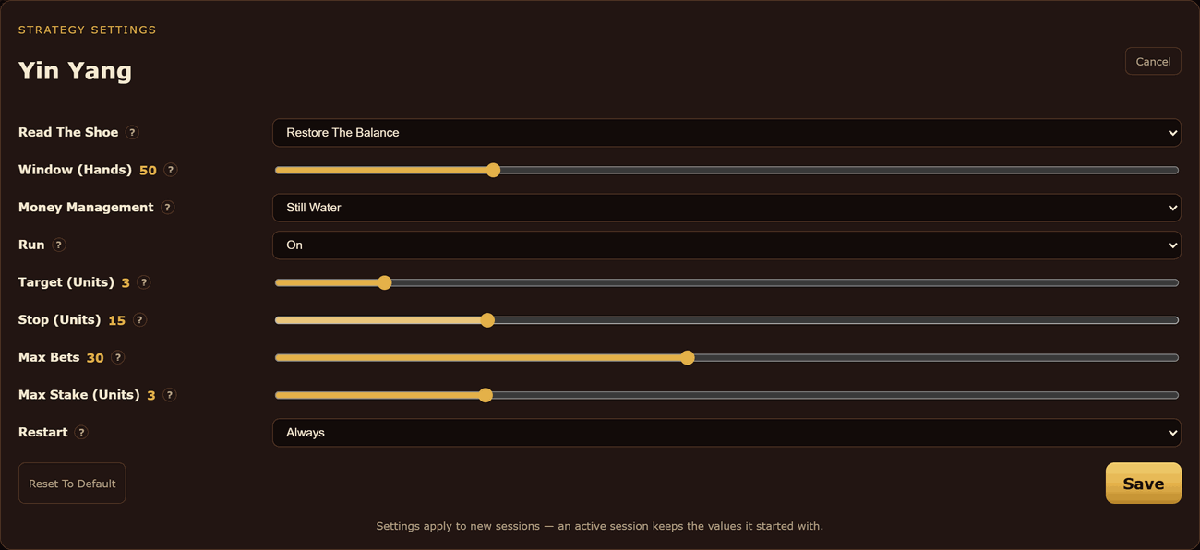
How it works. Flat betting. The same stake on every hand the strategy bets, win or lose. No ladders, no presses, no chasing. It's the default for every Classic, and every other mode below is compared with it.
| Still Water | Best | Typical | Worst | Ahead /100 | Busted /100 |
|---|---|---|---|---|---|
| One unit a hand | +36.5 | −1.6 | −39.9 | 45.7 C | 0.0 |
Pros
- The smoothest ride of the four. Its worst session in 5,000 was −39.9 units, and it never once busted a 100-unit bankroll.
- Easy to read. You always know what the next bet is, so you can follow the session at a glance.
- The perfect canvas for Dynamic Play. Press Up and Still Water steps to ×2, ×3 or ×5 and holds there; press Down and it eases back. You press the hot stretches by your own read and return to flat when the shoe cools.
Cons
- A capped ceiling. One unit a hand means a hot shoe pays one unit a hand. Its best session, +36.5, is the smallest of the four.
- No recovery built in. A loss stays a loss until the shoe pays it back one unit at a time.
Choose it if you're new to BaccaratNEURAL, you want the longest, calmest sessions, or you like to make the pressing decisions yourself.
Abacus: the calculated run
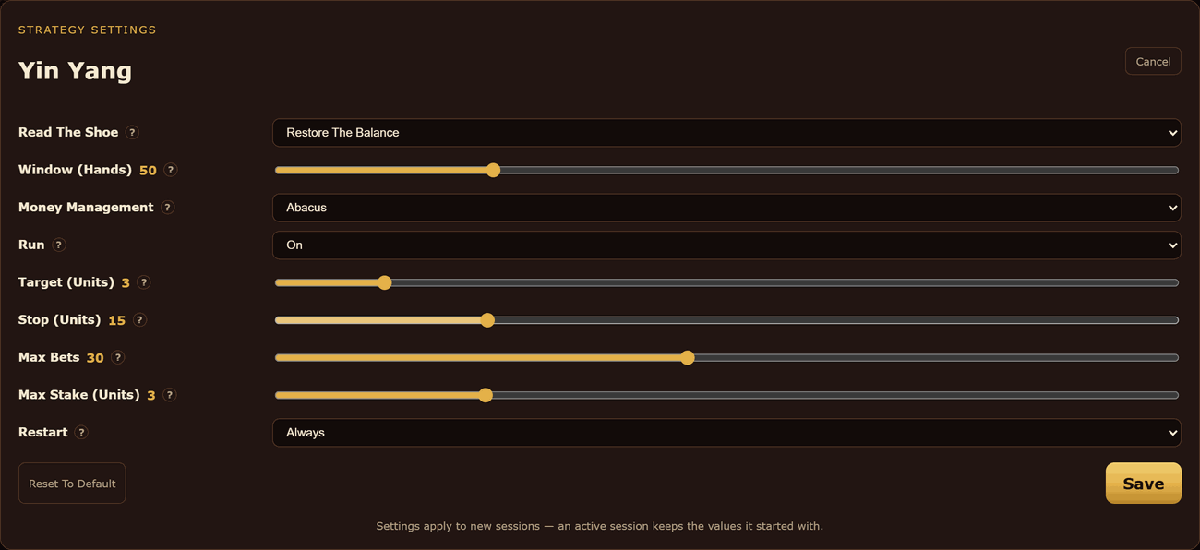
How it works. Abacus is the thinker of the family. It always plays in runs: you set a Target, a Stop, a Max Bets limit and a Max Stake. Then, before every single bet, Abacus works out the stake that gives the run its best chance of reaching its Target before its Stop. That's dynamic-programming bet sizing, the same mathematics used to plan the best move at every step of a problem, done for you on every hand. When a run ends, Restart decides whether the next one begins.
| Abacus | Best | Typical | Worst | Ahead /100 | Busted /100 |
|---|---|---|---|---|---|
| Target 1 · Stop 50 · 30 bets · Max Stake 5 (the Classics' default) | +108.3 | −3.8 | −100.0 | 46.7 C | 2.5 |
| Target 3 · Stop 15 · 30 bets · Max Stake 3 (Yin Yang's default) | +91.7 | −2.8 | −99.5 | 46.1 C | 0.1 |
Pros
- Every bet has a reason. No fixed ladder: the stake is recalculated hand by hand for exactly where your run stands.
- Built for hit-and-run play. Set a small Target and Abacus sizes its bets to bank it, then starts the next run.
- Hard limits you choose. Max Stake caps every bet and no bet is ever sized past your Stop.
- Big upside when runs chain together. Its best session at the default, +108.3 units, is nearly three times Still Water's.
Cons
- The default run is bold. Target 1 with a Stop of 50 means many small wins guarded by a deep stop. When the stop is hit, it costs. That's why its Busted /100 is 2.5.
- More settings to understand. Four run numbers and a Restart rule. A reward for the player who likes to tune, homework for the one who doesn't.
Choose it if you think in targets and stops and want every stake sized for the goal. For a calmer Abacus, use Yin Yang's run: Target 3, Stop 15, Max Stake 3 cuts Busted /100 to 0.1.
Rising Kite: ride the hot shoe
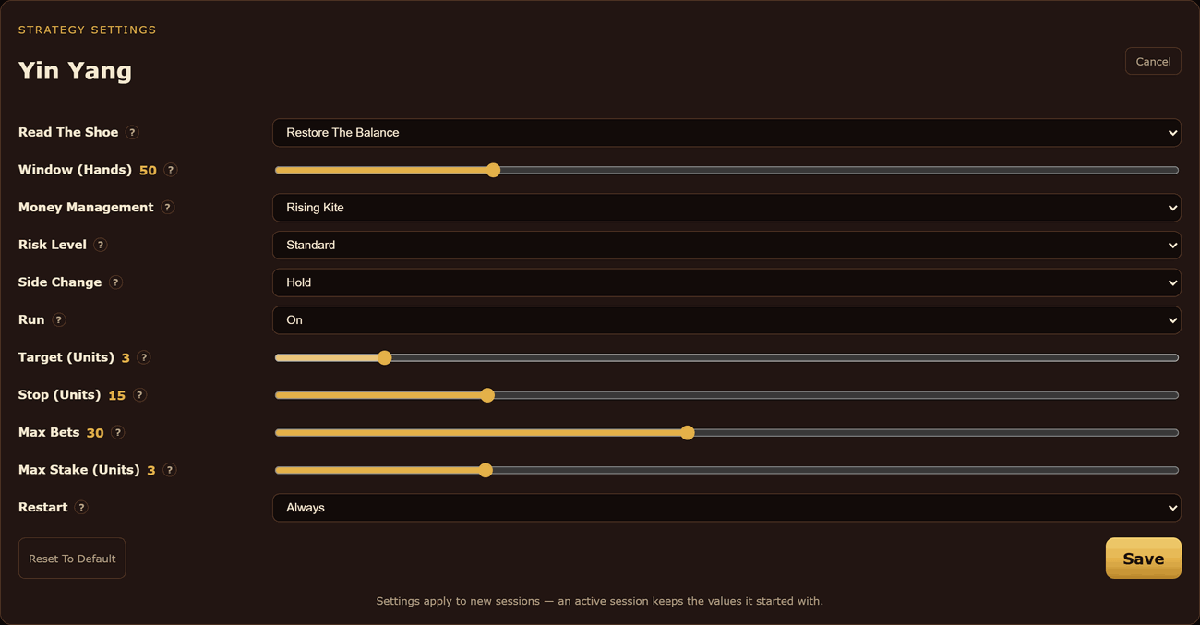
How it works. Rising Kite is a classic regression progression. It opens with a bigger attack bet. After the first win it pulls back one step, so the profit from that first win is already safe even if the next hand loses. Then it climbs one unit with every win, up to its ceiling. Any loss sends it straight back to the attack bet.
At Standard: attack with 3 units, drop to 2 after the first win, then climb one unit a win to at most 6.
| Rising Kite | Best | Typical | Worst | Ahead /100 | Busted /100 |
|---|---|---|---|---|---|
| Gentle: 2, then 1, up to 3 | +78.5 | −3.0 | −73.1 | 43.2 | 0.0 |
| Standard: 3, then 2, up to 6 | +130.6 | −5.2 | −99.9 | 43.0 | 0.1 |
| Bold: 4, then 3, up to 8 | +170.7 | −6.7 | −99.8 | 43.4 | 1.7 |
Pros
- The biggest ceiling in BaccaratNEURAL. Rising Kite at Bold posted a best session of +170.7 units: over $850 at a $5 unit. When the shoe runs your way, the kite climbs with it.
- Banks first, then presses. The pull-back after the first win means the shoe is paying for the climb.
- Simple to follow. Up on a win, back to the attack on a loss.
Cons
- More nights end behind. It ended ahead in about 43 sessions in 100, the fewest of the four, because it needs a streak to shine.
- Bigger swings. A bigger attack bet on every losing hand means a choppy shoe costs more than flat betting. Its typical session at Standard was −5.2 units.
Choose it if you love a streaky shoe and play for the big night. Start at Gentle: it never busted in 5,000 sessions and still reached +78.5.
Bamboo Ladder: bend, don't break
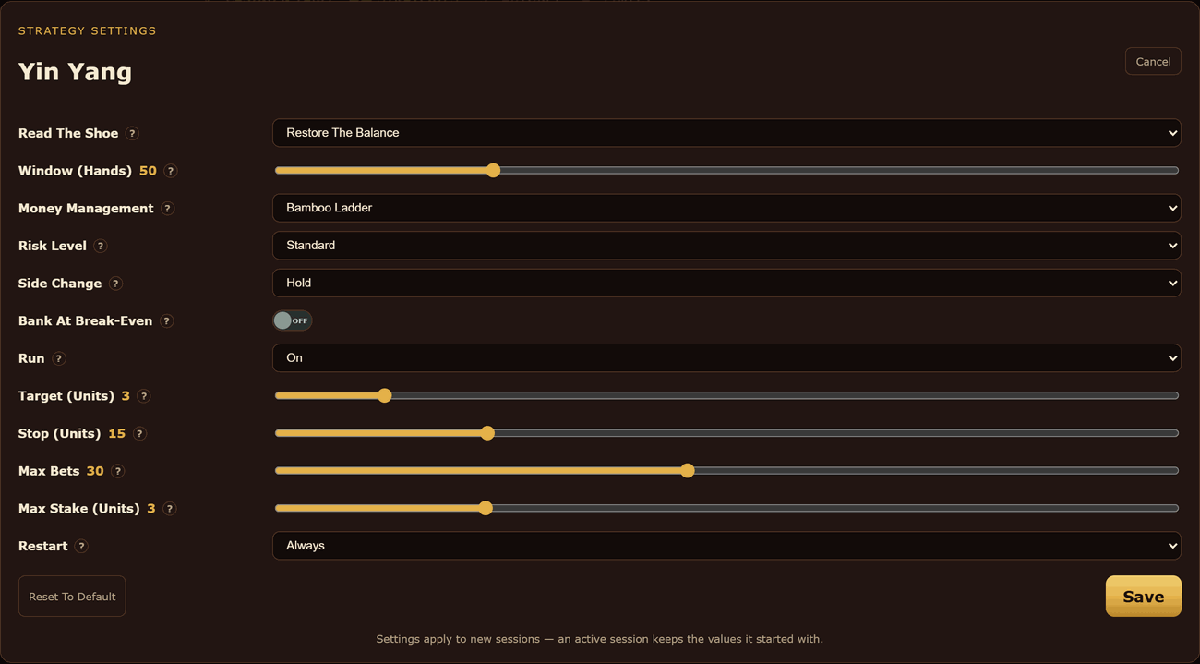
How it works. Bamboo Ladder is a recovery ladder. It bets one unit, and half a unit after a win. After a loss it starts climbing a ladder, rung by rung, until that loss is won back. A rung cap stops the ladder climbing forever: 4 rungs at Gentle, 6 at Standard and Bold. At Bold, the unit also grows by 20% after each profitable ladder, at most three times.
| Bamboo Ladder | Best | Typical | Worst | Ahead /100 | Busted /100 |
|---|---|---|---|---|---|
| Gentle: 4 rungs | +39.8 | −0.3 | −84.8 | 49.0 C | 0.0 |
| Standard: 6 rungs | +40.1 | +2.9 | −99.6 | 52.9 C | 0.2 |
| Bold: 6 rungs, presses 20% up to 3 times | +68.6 | +0.6 | −100.0 | 50.2 C | 2.2 |
Pros
- More nights ending ahead than any other mode. At Standard, Bamboo Ladder ended ahead in 52.9 sessions in 100.
- The only mode whose typical session is a winning one: +2.9 units at Standard.
- Gentle never busted a 100-unit bankroll in 5,000 sessions.
- Bank At Break-Even (with a run on) closes an open ladder the moment the run is level or ahead, so you can take the recovery and reset.
Cons
- It grinds, it doesn't explode. Its best session at Standard, +40.1, is a fraction of Rising Kite's. Bamboo Ladder is built for steady wins, not jackpots.
- When a ladder fails, it fails deep. The losses it doesn't recover gather into fewer, bigger sessions: its worst at Standard was −99.6 units against Still Water's −39.9.
Choose it if you want more sessions ending in the green and you're comfortable with a ladder doing the recovering. Pair it with a Stop Loss you're happy to reach.
Know your bankroll
Every mode above, apart from Still Water, asks for more chips on some hands than others. Two numbers tell you how much room it needs: the biggest single bet it placed, and its bad night, the session result that only 1 session in 20 did worse than.
| Money Management | Biggest bet | Bad night (1 in 20) | At a $5 unit |
|---|---|---|---|
| Still Water | 1 unit | −18.3 | −$91.50 |
| Abacus, Target 3 · Stop 15 · Max Stake 3 | 3 units | −49.0 | −$245 |
| Abacus, the Classics' default | 5 units | −75.1 | −$375.50 |
| Rising Kite, Standard | 6 units | −53.2 | −$266 |
| Bamboo Ladder, Standard | 6 units | −44.7 | −$223.50 |
These figures assume a 100-unit bankroll: 100 times your Starting Bet Unit. Play with less and a progression runs out of room sooner. Whichever mode you choose, set a Stop Loss at Step 4 that you're happy to reach.
The fine print that makes it yours
- Risk Level. Rising Kite and Bamboo Ladder each come in Gentle, Standard and Bold, the exact settings measured above. Custom opens the numbers themselves, within set bounds.
- Side Change. Follow The Shoe and Chop switch between Player and Banker. Hold carries the progression across the switch; Reset starts it fresh.
- Runs for any mode. Turn Run on and any mode plays to a Target, a Stop and a Max Bets limit, with Max Stake capping every bet and Restart deciding what happens next. Abacus always plays a run.
- Exact payouts. Every progression counts the Banker commission to the fraction of a unit, and a Tie on Player or Banker holds the plan where it was (it still counts toward a run's Max Bets).
Dynamic Play: your hand on every mode

Whichever mode you pick, you're never locked in. Switch on Dynamic Play and you get the final word on any hand: Up and Down move one step along your mode's own plan, Aim Player and Aim Banker put the bet on your read, and Skip Hand sits one out. Leave it alone and your money management plays exactly as designed. Step in, and it carries on from the bet you really placed.
Which one is right for you?
- Want the calmest, longest sessions? Still Water. Add Dynamic Play to press by feel.
- Think in targets and stops? Abacus. It does the maths on every hand.
- Chasing the big night on a streaky shoe? Rising Kite. Start at Gentle.
- Want more nights ending ahead? Bamboo Ladder. Standard is its sweet spot.
The best part: you don't have to choose just once. Change mode between sessions in Configure, and turn on Strategy Watch to have BaccaratNEURAL paper trade the other strategies alongside your live one on the same shoe.
Get BaccaratNEURAL, open Configure, and give your favourite Classic the money management it deserves.
— Team Viper