Roulette looks incredibly simple when you first see it.
Pick a number. Pick a color. Put down a chip. Spin the wheel.
That simplicity is part of what makes roulette so appealing. But after spending years studying the game, experimenting with roulette strategies, backtesting ideas and looking at millions of spins, I realized there were some things I desperately wish I had understood when I started.
Not because there is some secret formula that makes every spin predictable.
There isn't.
What I wish I had understood was how much wheel selection, discipline, bankroll management, mental state, session management and understanding the true risk of a roulette strategy actually matter.
In fact, many of the biggest mistakes I've seen players make have very little to do with picking the wrong number.
They come from making the wrong decision.
If you're new to roulette—or even if you've been playing for years—these are the lessons I wish someone had explained to me at the beginning.
1. Choose the Right Roulette Wheel — NEVER Play Triple-Zero Roulette
If there is one piece of advice I would give a roulette player before anything else, it's this:
Count the zeros.
Today you may encounter three different roulette wheels:
- Single-zero roulette: 0 plus numbers 1–36
- Double-zero roulette: 0 and 00 plus numbers 1–36
- Triple-zero roulette: 0, 00 and 000 plus numbers 1–36
They may look like essentially the same game.
Mathematically, they are not.
A standard single-zero European roulette wheel has a house edge of approximately 2.70%.
A traditional American double-zero wheel increases that to approximately 5.26%.
Triple-zero roulette pushes it to approximately 7.69%.
NEVER Play Triple-Zero Roulette
NEVER play triple-zero roulette. You are accepting worse odds for the same payouts. If there's a double-zero or single-zero wheel nearby, walk past the triple-zero table. Don't give Vegas an edge it didn't earn.
This is something that still amazes me.
I've watched people sit down at a triple-zero roulette table when a double-zero table was only a short distance away.
Why?
The payouts aren't better.
Red or black still pays 1-to-1.
A dozen still pays 2-to-1.
A straight-up number still normally pays 35-to-1.
You're simply accepting another green pocket that can beat you.
There are plenty of difficult decisions in roulette.
This isn't one of them.
My order of preference is simple:
Single zero first → double zero if necessary → never triple zero.
Before thinking about progressions, corners, dozens, streaks, patterns or roulette betting systems, make the easiest mathematical decision available:
Choose the best game.
2. Roulette Discipline May Matter More Than Your Strategy
After choosing the right wheel, this may be the most important lesson in this entire article.
Have a plan before you start playing—and follow it.
Players spend enormous amounts of time searching for better roulette strategies.
What should I bet?
When should I increase?
When should I change bets?
When should I press?
Those questions matter.
But there is another variable that may matter just as much:
The person executing the strategy.
A good strategy in the hands of an undisciplined player can become a bad strategy very quickly.
In a short roulette session, poor decisions, excessive bet sizing, chasing and tilt can overwhelm what the house edge alone would be expected to cost over that limited number of spins.
A player becomes frustrated.
They increase their wager outside the plan.
They abandon their strategy.
They make an impulse bet.
They decide they need to recover a loss immediately.
They keep playing after reaching their stop.
And suddenly a manageable losing session becomes a major bankroll loss.
Tilt Changes Everything
Poker players use the word tilt, but the concept applies perfectly to roulette.
Tilt happens when anger, fear, excitement or desperation starts making decisions that your rational mind wouldn't normally make.
Roulette gives you plenty of opportunities to tilt.
You lose six bets in a row.
The number you just stopped betting hits.
You almost reach your profit target and then give half of it back.
You watch the exact bet you considered making win after deciding not to place it.
Suddenly you want revenge.
But the roulette wheel doesn't know you're angry.
Chasing Losses Is Not a Roulette Strategy
One of the most dangerous thoughts in gambling is:
"I just need to get back to even."
Once that thought takes over, your original plan can disappear.
Your bets get larger.
Your acceptable risk changes.
Your session gets longer.
And decisions that would have seemed ridiculous before you sat down suddenly feel reasonable.
That is chasing.
Your strategy should determine what you do after a loss.
Your emotions shouldn't.
Before you play, know:
- what strategy you're going to play,
- your starting wager,
- how the progression works,
- when bets increase or decrease,
- your profit objective,
- your maximum acceptable loss,
- and exactly what ends the session.
Then follow it.
The wheel controls where the ball lands.
You control what you do next.
3. Roulette Bankroll Management: Protect Your Bankroll Above Everything Else
Your bankroll isn't simply money.
Your bankroll is opportunity.
As long as you have a bankroll, you have another session.
Another table.
Another opportunity.
Once the bankroll is gone, those opportunities disappear with it.
That's why one of my highest priorities isn't simply trying to win.
It's staying in the game.
Sometimes that means accepting a loss.
You Don't Have to Rescue Every Losing Session
Imagine you're down $25.
You increase your risk trying to recover it.
Now you're down $50.
You become more aggressive.
Now you're down $100.
Eventually, what began as a relatively small losing session has turned into a serious bankroll event.
All because you were unwilling to accept the original $25 loss.
Sometimes the smartest thing you can say is:
"This session didn't work. I'm done."
Don't risk tomorrow's opportunities trying to repair today's loss.
There will always be another spin.
Another table.
Another night.
But only if you still have a bankroll.
Protect the bankroll first. Everything else depends on it.
4. Set Your Daily Gambling Limit Before You Play — and Leave the Rest Behind
Before you walk into the casino, answer one question:
How much money am I willing to lose today?
Not how much you hope to win.
Not how much money is available in your bank account.
How much can you responsibly lose today without creating a financial problem for yourself?
Make that decision before you start playing.
Then bring that amount.
Leave the rest behind.
If you're staying at a hotel, keep the rest of your bankroll somewhere secure.
I would go even further.
Leave your credit cards in the room safe.
NEVER Go Back to the ATM to Chase a Loss
This is one of my strongest personal rules.
Never—I mean NEVER—go to an ATM because you lost the money you planned to play with.
You decided your limit when you were calm.
Don't renegotiate that limit while you're upset.
And absolutely:
Never take a cash advance on a credit card to continue gambling.
At that point, you aren't simply risking today's entertainment money.
You're borrowing money—potentially with fees and interest—to continue a losing session.
That's a giant flashing stop sign.
If the money you brought is gone:
The session is over.
Put a Physical Barrier Between Yourself and a Bad Decision
Suppose your maximum risk tonight is $200.
Bring $200.
If you lose it, you don't have another $500 sitting in your wallet tempting you to change your mind.
Your remaining bankroll isn't there.
Your credit card isn't there.
Your rational self made the decision before your emotional self had an opportunity to interfere.
That's not weakness.
That's discipline.
Take Frequent Breaks
Roulette can create tunnel vision.
Bet.
Spin.
Win.
Bet.
Spin.
Lose.
Bet again.
Time disappears.
Get up periodically.
Walk around.
Get some water.
Have something to eat.
Look at your balance.
Ask yourself:
Am I still following my plan?
Am I still thinking clearly?
Am I playing my strategy—or am I trying to get something back?
A short break can completely change your perspective.
Remember three rules:
Don't chase.
Don't overextend.
Don't borrow money to gamble.
If gambling stops being entertainment and begins affecting your finances, relationships, work or your ability to stop, get help.
The Gamblers Anonymous National Hotline is 855-222-5542 (855-2CALLGA).
There is nothing to prove at a roulette table.
Sometimes the strongest decision you can make is:
"I'm done for today."
5. The Gambler's Fallacy: The Roulette Wheel Owes You Nothing
This is one of the most expensive lessons roulette players learn.
And I learned it early.
I was on a cruise when I came across a roulette table where black had hit 14 times in a row.
People started noticing.
Then there was almost a rush toward the table.
Players began putting increasingly large amounts of money on red.
The reasoning seemed obvious:
"Red is due."
Then black hit again.
And again.
Within a few minutes, I watched more money disappear than I had seen lost in almost any five-minute stretch of gambling in my life.
Those players weren't betting red because red had somehow become more likely.
They were betting red because they believed the wheel owed them a correction.
It didn't.
The Wheel Owes You Nothing
That sentence is worth remembering:
The wheel owes you nothing.
It doesn't care that black has appeared five times.
Ten times.
Fourteen times.
A streak doesn't create a debt that the wheel has to repay.
This belief is known as the gambler's fallacy, and I believe fighting roulette streaks because they "have to end" is one of the fastest ways a player can destroy a bankroll.
Of course every streak eventually ends.
That's not the mistake.
The mistake is assuming:
"Eventually" means "next."
That's when somebody says:
"There's no way black can hit again."
So they double.
Black hits.
They double again.
And again.
The wheel doesn't care.
In What Race Would You Bet on the Loser?
I've always thought about it this way:
In what race would you intentionally bet against the competitor who keeps winning simply because you think the winner is overdue to lose?
Yet roulette players do exactly that.
They see black winning and pile money on red.
One dozen keeps appearing, so they bet everything on the other two.
A wheel sector keeps producing numbers, so they immediately abandon it.
Why?
Because:
"It can't keep happening."
But it can.
If I'm going to incorporate recent results into a strategy at all, I'd rather respect what's happening than repeatedly increase my wager fighting it because I believe a reversal is owed.
Now, an important point:
A streak does not make the streak mathematically more likely to continue on the next independent spin either.
Following black after 14 blacks doesn't magically create an advantage.
But there is a huge difference between following a predefined strategy and throwing larger and larger amounts of money against a streak because you believe the wheel must change.
One is a strategy decision.
The other is the gambler's fallacy.
The streak doesn't need to last forever to ruin you.
It only needs to last:
Long enough to exhaust your bankroll.
The wheel owes you nothing.
Never forget it.
6. Set Reasonable Roulette Session Targets — Become a Hit-and-Run Player
One of the biggest changes I made as I gained experience was realizing I didn't need to sit at a roulette table for hours.
My thinking became almost the opposite:
Get in. Play your plan. Reach a reasonable target if the opportunity presents itself. Cash out. Walk away.
Become a hit-and-run player.
Roulette has a mathematical house edge.
The longer you play and the more money you cycle through the game, the more total wagering volume you expose to that edge.
A short session doesn't remove the house advantage.
But it limits the amount of action exposed to it.
Just as importantly, shorter sessions can reduce the opportunities for boredom, fatigue, greed and tilt to turn a good session into a bad one.
We've all seen it.
A player is up nicely.
They decide:
"Just a little more."
Then they give some back.
Now they want to recover what they just gave back.
And suddenly the winning session is gone.
Break a Larger Goal Into Mini-Sessions
Suppose you sit down with $200 and decide your overall target for the evening is 20%.
That's $40.
Rather than deciding you're going to remain at one table until you make $40, consider breaking the goal into smaller mini-sessions.
For example:
Four separate 5% targets.
On $200, 5% is $10.
Session one reaches $10?
Cash out.
Take a break.
Reset.
If you choose to play again later, begin another mini-session.
This distinction is critical:
5% is a target—not an expected or guaranteed return.
Roulette doesn't owe you 5%.
It doesn't owe you 20%.
A session may win.
It may lose.
You may reach your stop-loss before reaching the target.
The value of a reasonable win target isn't that roulette suddenly becomes profitable.
It's that you've created a clear reason to:
Stop when things go your way.
Cash the Ticket
When you reach your objective:
End the session.
If you're playing electronically, cash the ticket.
If you're playing chips, color up.
Stand up.
Walk away from the table.
That physical act matters.
Don't immediately think:
"I'm playing with the casino's money now."
No.
Once you've won it:
It's your money.
Removing the profit from play protects it from the next decision.
You can always make a completely new decision later.
Don't Turn a Great 20-Minute Session Into a Bad Three-Hour Session
You don't need to win the entire night in one sitting.
Sometimes:
The best roulette session is a short roulette session.
7. Know Your Roulette Strategy Before You Bet Real Money
Your strategy decisions should mostly be made before you arrive at the table.
Know what you intend to play that night.
Make a list.
Practice those strategies beforehand.
Backtest them.
Understand them.
You can change the order.
You can decide not to play one.
You can end the night early.
But stick primarily with strategies you actually understand.
The casino floor is not the place to learn your strategy.
I can't tell you how many times when I was starting out that I found a roulette strategy online—often on YouTube—that looked incredible.
Win.
Win.
Win.
The bankroll climbed beautifully.
Sometimes the strategy had some version of Martingale or another aggressive progression buried inside it.
During the demonstration, everything looked great.
Then I brought it to the table.
And somehow it didn't perform anything like the video I had watched.
Eventually I understood why.
I had watched the good sequence.
I didn't understand what happened when the strategy encountered the bad one.
Learn How the Strategy Loses, Not Just How It Wins
This is one of the biggest lessons I've learned:
Knowing how a strategy wins isn't enough. You need to know how it loses.
Before putting real money behind a roulette strategy, I want to know:
- What does it do after a win?
- What does it do after a loss?
- How rapidly can the wager escalate?
- What is its average drawdown?
- What is an unusually bad drawdown?
- How frequently does it reach the intended profit target?
- How often does it reach the stop-loss first?
- What's the longest losing sequence observed in testing?
- What is the largest wager it can create?
- How much of the bankroll can be exposed on one spin?
- How many spins does the typical session take?
- How volatile are the results?
- What does the worst 5% of sessions look like?
- How much bankroll does the strategy realistically require?
Those questions are considerably more important than:
"Did the person in that video win with it?"
Become an Expert at the Strategies You Play
I'd rather walk into a casino knowing three roulette strategies exceptionally well than carrying 30 strategies I barely understand.
When you know your strategy, a few losses don't immediately cause you to abandon it.
You understand what normal variance looks like.
You know what the progression is supposed to do.
You recognize when the strategy is experiencing an unusually difficult session.
And you know when your predetermined risk rules say:
Stop.
Preparation creates discipline.
Uncertainty creates improvisation.
And improvisation with real money can become expensive very quickly.
8. Understand Roulette Strategy Risk Before You Play — That's Why We Built Viper
In my experience, one of the biggest reasons players bust their bankroll isn't necessarily that they picked the wrong bet. It's that they never understood the risk hidden inside the strategy they brought to the table.
They know how the strategy wins.
They don't know how it loses.
They know what happens during the good sequence.
They don't know what happens during the ugly one.
They know the starting wager.
They don't know how large that wager can become after a prolonged losing sequence.
They know somebody demonstrated the strategy successfully online.
They don't know its drawdown, volatility, failure rate or realistic bankroll requirement.
And by the time they discover those answers at a real table, the lesson may already have become expensive.
Viper Can Answer the Risk Question Before You Put Your Bankroll on the Line
This may be one of the most valuable things Viper can do.
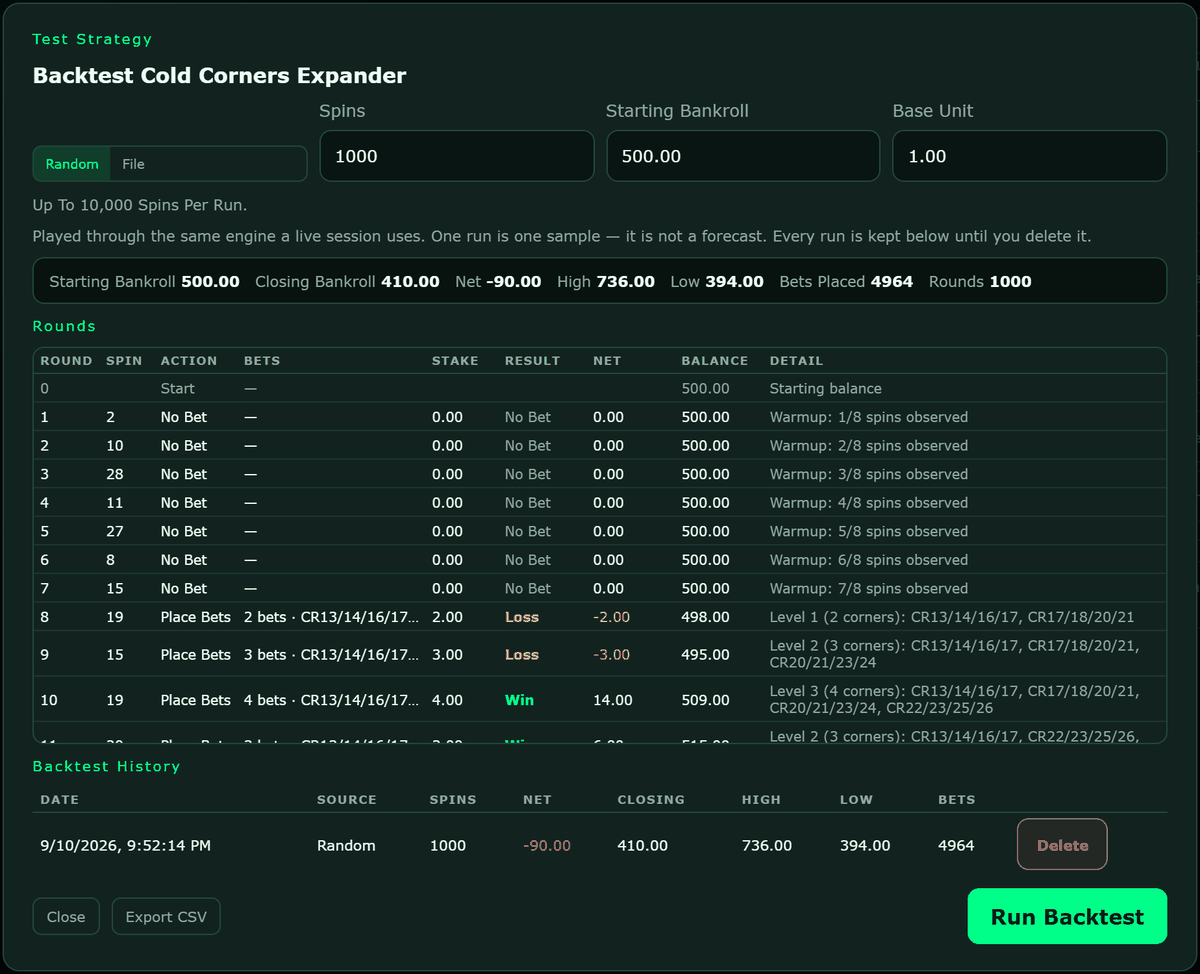
Viper can model virtually any roulette strategy and help answer the risk questions that are extremely difficult to understand from watching a handful of spins.
Viper can't guarantee a strategy will win.
Nothing can.
But Viper can expose risks that might otherwise surprise you at the table.
And understanding those risks before you play can help protect your bankroll.
This Is Why We Built Viper
As I became more serious about studying roulette, I realized I didn't simply need more strategies.
I needed better information about the strategies.
A strategy can look fantastic during a handful of sessions and still contain enormous hidden risk.
A high session win rate can hide occasional very large losses.
A smooth-looking progression can suddenly explode in bet size.
A strategy that reaches +5% frequently might also have a nasty tail where a small percentage of sessions experience very large drawdowns.
What I wanted was the ability to take virtually any roulette strategy, model its rules, run it through large amounts of spin data and answer the questions a player really needs answered.
That's what Viper was built to do.
Don't Just Ask, "Does This Roulette Strategy Win?"
Ask better questions.
What is the strategy's average drawdown?
What is its median drawdown?
What does its worst 5% of sessions look like?
What about its worst 1%?
How often does it reach a 5% profit target before reaching its stop-loss?
How often does it reach 10%?
What's the average number of spins required to reach its target?
How frequently does the strategy finish a session profitable?
How frequently does the stop-loss get hit?
What is its longest losing streak?
What is the largest progression level reached?
What is the maximum single-spin exposure?
What is the average wager size?
How much bankroll would have survived 90%, 95% or 99% of the tested sessions?
How much variance exists between the strategy's best and worst sessions?
Does most of its positive performance come from ordinary sessions—or from a small number of unusually favorable ones?
How frequently does it experience a major drawdown before eventually reaching its goal?
Those are risk questions.
And they're questions roulette players should understand before putting real money behind a strategy.
Modeling a Strategy Is Very Different From Watching a Strategy
Watching somebody play a strategy for 20 spins shows you what happened during:
Those 20 spins.
Modeling the strategy lets us ask:
What happens when we repeat this thousands of times across many different sequences?
That's an entirely different level of understanding.
Because Viper can model the rules behind virtually any roulette strategy, we can examine much more than one favorable session.
We can study:
- the distribution of session outcomes,
- average and extreme drawdowns,
- losing sequences,
- wager escalation,
- progression levels,
- target-hit frequency,
- stop-loss frequency,
- session duration,
- bankroll requirements,
- volatility,
- and failure conditions.
Most importantly, we can study:
The things you hope never happen.
Those are exactly the things you should understand before putting your bankroll behind a strategy.
Sometimes the Best Roulette Strategy Is the One Viper Tells You Not to Play
This is one of my favorite things about testing.
Sometimes a strategy looks fantastic.
Then you test it properly.
And the data says:
Stay away.
Maybe the progression becomes too large.
Maybe the drawdown is unacceptable.
Maybe the win rate looks attractive but the losing sessions are enormous.
Maybe the strategy reaches a small target frequently but occasionally gives back dozens of previous winning sessions.
That's valuable information.
Finding a dangerous strategy before it costs you real money can be every bit as valuable as finding a promising one.
Give the Player Better Data
Casinos understand their games.
They understand probability.
They understand expected value.
They understand variance.
They operate across enormous numbers of wagers.
Players should understand the risk on their side of the table too.
That's the gap we want Viper to help close.
We're not claiming software can change the mathematics of roulette.
It can't.
We're doing something more practical:
Giving players the ability to understand the strategies they're choosing to risk money on.
Viper is your roulette strategy laboratory.
Build the strategy.
Model it.
Backtest it.
Stress it.
Understand it.
Compare it.
Find the promising ones.
Expose the highly volatile ones.
Reject the dangerous ones.
And only then decide whether it's something you want to play.
Data Before Dollars
If I had one rule for roulette strategy selection today, it would be:
Data before dollars.
Don't discover your strategy's maximum drawdown at a real roulette table.
Don't discover how quickly its progression grows after you've already lost five spins.
Don't discover that an impressive win rate is hiding a devastating loss profile with your own bankroll.
Find those things out first.
One of the easiest ways to bust a bankroll is to play a strategy whose risk you never understood.
Viper exists to help answer that question before you play:
"What is the real risk of this strategy?"
That answer might help you identify a strategy worth investigating.
Just as importantly:
It might tell you which strategy not to play at all.
What I Wish I Knew Before I Started Playing Roulette
Looking back, my biggest roulette lessons aren't about a particular number, progression or betting pattern.
They're much simpler.
Choose the best wheel.
Be disciplined.
Protect your bankroll.
Decide your risk before you play.
Never chase.
Remember that the wheel owes you nothing.
Set reasonable session targets and learn to walk away.
Know your strategies before risking real money.
And above all:
Understand the risk.
Roulette is unpredictable.
Your behavior doesn't have to be.
The wheel controls the outcome.
You control the decisions.
That's what I wish I knew when I started.
Frequently Asked Questions About Roulette Strategy and Bankroll Management
Is triple-zero roulette bad for players?
Triple-zero roulette has a higher house edge than standard single-zero or double-zero roulette while maintaining the familiar standard payouts.
If a comparable single-zero or double-zero game is available, I would choose it instead.
Don't give the casino an edge it didn't earn.
What is the best roulette wheel to play?
When comparable rules and table conditions are available, I prefer single-zero European roulette because its standard house edge is lower than double-zero or triple-zero roulette.
If single zero isn't available, I would choose double zero before triple zero.
How much money should I risk playing roulette?
Only an amount you can responsibly afford to lose.
Decide your maximum risk before you begin playing, bring only the amount you've allocated for gambling, and don't increase that limit because the session is losing.
Should I go to an ATM after losing my roulette bankroll for the day?
My rule is:
Never.
If you lose the amount you decided you were willing to risk, the session is over.
Changing the limit while you're emotional defeats the purpose of establishing the limit beforehand.
Should I use a credit card cash advance to continue gambling?
No.
Never borrow money to chase gambling losses.
What is the gambler's fallacy in roulette?
The gambler's fallacy is the belief that previous independent results make the opposite outcome "due."
For example, after a long streak of black, a player may believe red must appear next.
It doesn't have to.
The streak will eventually end, but:
Eventually doesn't mean next.
Should I follow roulette streaks?
A streak does not make its continuation mathematically more likely on the next independent spin.
The important lesson is to avoid risking increasingly large amounts against a streak simply because you believe it must reverse.
What is a reasonable roulette profit target?
There is no guaranteed or universally correct profit target.
I prefer predefined, modest session objectives rather than sitting indefinitely trying to achieve one large result.
For example, someone with an overall 20% target might choose to structure their play as several separate 5% mini-session targets instead.
Those percentages are goals—not expected or guaranteed returns.
What should I know about a roulette strategy before playing it?
At minimum, I want to understand its:
- average drawdown,
- extreme drawdown,
- progression behavior,
- maximum wager,
- maximum spin exposure,
- profit-target hit rate,
- stop-loss rate,
- average session length,
- losing streaks,
- volatility,
- bankroll requirement,
- and worst observed sessions during testing.
Knowing how a strategy wins is not enough.
You need to know how it loses.
How can Viper help protect my roulette bankroll?
Viper can model and backtest virtually any roulette strategy so you can understand its risk profile before deciding whether you want to play it.
That analysis can include drawdown, volatility, wager escalation, target-hit rates, stop-loss frequency, losing streaks, session duration and bankroll requirements.
Viper cannot guarantee future results.
What it can do is help identify risks that might otherwise remain hidden until real money is already on the table.
What does Viper roulette software do?
Viper allows roulette strategies to be modeled, backtested and analyzed across large amounts of spin data.
Its purpose isn't simply to tell you whether a strategy won.
It's designed to answer the harder questions about:
risk, drawdown, volatility, progression exposure, bankroll requirements and the likelihood of reaching specific session objectives during testing.
One Last Thing — Help Another Roulette Player Avoid These Mistakes
If this article helped you, please share it with another roulette player—especially someone who is just getting started.
I made plenty of mistakes when I was learning.
I chased losses.
I trusted strategies I hadn't tested enough.
I stayed at tables too long.
I underestimated variance.
And I learned some lessons with real money that I would much rather have learned from data first.
If sharing this article helps even one new player avoid those same mistakes, protect their bankroll and make better decisions at the table, then it was worth writing.
Share this article with someone who needs to read it before their next roulette session.
You might save them from learning these lessons the expensive way.
Roulette involves financial risk and outcomes are uncertain. No strategy, progression, backtest or software can guarantee future results. Viper is designed for strategy analysis and decision support. Never wager money you cannot afford to lose. If gambling is becoming difficult to control, the Gamblers Anonymous National Hotline is 855-222-5542 (855-2CALLGA).
— Dave