I work on BaccaratNEURAL, and I play it. I doubled my bankroll with it, and I didn't do it with one big night. I did it the boring way: short sessions, small wins, and getting up from the table.
No session tried to double anything. Each one had a small number to reach. When it reached that number, it was over. The bankroll grew one of those at a time.
That's one player's result, and your sessions will be your own. What I can give you is the setup, and the numbers behind it that you can check for yourself in the app.
Only gamble with money you can afford to lose.
Discipline is the whole strategy
Every baccarat player knows the feeling. You're up a little. The shoe feels good. One more hand. Then one more after that.
Every one of those hands pays the house. A Banker bet costs you 1.06% of what you stake, on average, and nothing changes that price. No pattern lowers it and no progression lowers it. What you do control is how many hands you pay it on.
So I play by three rules:
- Set the number before the first card. A Target and a Stop, chosen while I'm calm.
- A small win is a win. I don't turn it into a bigger one by staying.
- The run ends, I leave. Not one more hand. Not one more shoe.
The rules are simple. Following them at the table is the hard part, so I let the app hold me to them. This is the setup that does it.
Follow The Banker: the lowest price in the game
Every bet is two choices: the side and the size. Abacus handles the size. Follow The Banker handles the side, and it backs Banker every hand, because no other bet on the table costs less. There's no pattern to read and no decision to second-guess.
Abacus: built to get you off the table
Abacus is a progression with a finish line. You give it a run:
- Target (Units): the profit that ends the run.
- Stop (Units): the most the run may lose. You choose it, and no bet is ever sized past it.
- Max Bets: how many bets the run gets.
- Max Stake (Units): the biggest single bet you'll allow.
There's no fixed ladder. Before every hand, Abacus works out the stake that gives this run its best chance of reaching the Target before the Stop, from exactly where the run stands. With Restart set to Off, it plays one run and stops.
The quickest way off the table takes one hand. With a $5 unit, a one-unit Target and Banker Commission Counted, Abacus opens at $10. One Banker win pays $9.50 and the run is over.
It also knows what to do when the first hand goes wrong. Here's an example run I've worked through from the app's own table, not a session of mine. The Target is 1 unit, the Stop 20, on a $5 unit:
| Hand | Run stands at | Abacus bets | Chance of reaching the Target | Result |
|---|---|---|---|---|
| 1 | $0.00 | $10 | 91% | Lose |
| 2 | −$10.00 | $15 | 82% | Lose |
| 3 | −$25.00 | $25 | 68% | Win, pays $23.75 |
| 4 | −$1.25 | $5 | 91% | Win, pays $4.75 |
| 5 | +$3.50 | $5 | 95% | Win, pays $4.75 |
Two losses, and the run still finishes at +$8.25 in five hands. Look at hand 4: the moment the run is nearly back, the bet drops from $25 to $5. Abacus only bets what the run needs.
Five hands is typical. We played Follow The Banker on Abacus as one run per session, Target 1, Stop 50, Max Bets 30, Max Stake 5, across 5,000 sessions, dealt card by card from eight-deck shoes with the 5% commission. The run finished ahead 93.6 times in 100, with a typical result of +1.9 units, in about 5 hands. The same strategy betting one unit flat for a full session played 119 hands.
A small target is reached often because it's small. A run that doesn't get there ends at its Stop or its Max Bets, and you chose both before you sat down. That's the trade, and you make it on purpose. Either way, Abacus places nothing more, and that's your signal to get up.
The Abacus Modeler: see your chances before you sit down
This is the screen that changed how I pick a session. Choose Abacus at Begin Session, Step 2 > Configure > Money Management, and the Abacus Modeler appears at the top of Configure.
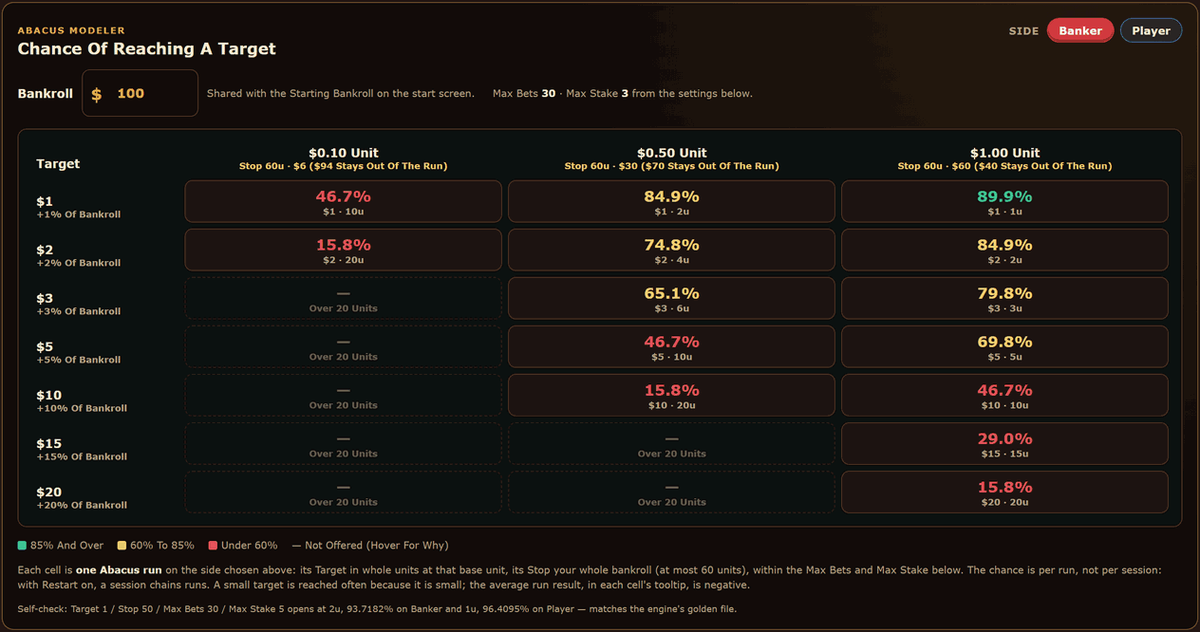
Type in your bankroll. The columns are your table's betting units and the rows are dollar targets. Each cell shows the chance that one Abacus run reaches that target with your bankroll as its Stop, up to 60 units. Tap a cell and it sets your Target, your Stop and your Base Unit in one go.
Here's what it shows for a $100 bankroll on Banker, at Max Bets 30 and Max Stake 5:
| Target | $1 unit, Stop $60 | $5 unit, Stop $100 | $10 unit, Stop $100 |
|---|---|---|---|
| +$5 | 81.3% | 91.1% | Below One Unit |
| +$10 | 66.0% | 87.1% | 83.8% |
| +$20 | 39.5% | 79.9% | 77.4% |
Look at the +$20 row. It's the same $20 target, and it's twice as likely at a $5 unit as at a $1 unit. Part of that is the Stop, because the $5 column risks your whole $100 and the $1 column stops at 60 units. The rest is the number of hands. The $1 unit has to grind out 20 units, a few at a time, paying the house on every hand.
Now read down any column. The smaller the target, the better the chance. That's the case for small wins, in numbers, before you've placed a bet.
Banker Commission: Counted or Ignored
A Banker win pays 0.95 to 1, and that small detail changes the next bet. Abacus gives you a choice, Banker Commission, in the same Configure panel.
Counted is the default. Abacus sizes every bet knowing about the 5%. One unit on Banker wins 0.95 units, which falls just short of a one-unit Target, so Abacus opens with two units.
Ignored sizes and measures the run as if a Banker win paid even money. A one-unit Target opens with one unit, and one Banker win reaches it. Here's the same run both ways, at Max Bets 30 and Max Stake 5:
| $100 bankroll, $5 unit, Target 1, Stop 20 | Opening bet | Chance in the Modeler |
|---|---|---|
| Banker Commission Counted | $10 | 91.1% |
| Banker Commission Ignored | $5 | 95.7% |
Ignored isn't a discount. The casino still keeps its 5%, so that winning $5 bet puts $4.75 in your balance while the run counts +$5. The chance is higher because the real target is a little lower. The Stop is measured the same way, so your real money sits slightly under the run's figure whenever Banker has won.
So choose what suits your session. Counted if the Target has to be real money in your balance. Ignored if you want the smallest opening bet and a clean one-win finish. The Modeler's Banker cells follow whichever you pick.
Table Sense: how the shoe has been flowing
The small dial in the Roads heading is Table Sense, with a P on its left and a B on its right. It reads the shoe's last five Player and Banker hands, the newest counting most, with Ties left out. Its needle and its words give you Even, Leaning Player, Leaning Banker, Strong Player or Strong Banker. It starts over at New Shoe.
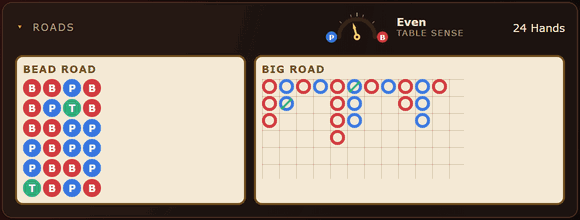
You get the shoe's recent flow at a glance, without counting beads. It describes where the shoe has been, not where it's going. Every hand is independent.
Dynamic Play: changing sides when Player starts to streak
Follow The Banker never reads the shoe. Sometimes you want to, and that's what Dynamic Play is for. Answer Yes to Use Dynamic Play? at Begin Session, Step 3, and you get the final word on every hand.

Say Player starts to run and Table Sense swings to Strong Player. Press Aim Player and that hand's bet moves across, with Abacus sizing the stake for that side. A Player win pays even money, with no commission. The run carries on from what was really placed.
An aim covers one hand. On the next hand, Follow The Banker goes back to Banker unless you press it again. Stop pressing and you're back on the lower-priced bet.
Be clear about what this is. Banker is still the cheaper bet, and a streak doesn't change the next hand's odds. Aiming is a choice about how you want to play the shoe in front of you, and you make it with the gauge in plain view. Your Target and Stop stay exactly where you put them.
My session, step by step
- Pick your number before you open the app.
- Begin Session, Step 2: choose Follow The Banker, press Configure, and set Money Management to Abacus.
- Read the Abacus Modeler and tap the cell you can live with. Set Banker Commission and turn Restart to Off.
- Begin Session, Step 3: answer Yes to Use Dynamic Play? if you want your hand on the side.
- Play the run. Keep an eye on Table Sense. Let Abacus size the bets.
- Get up. Take the small win. Come back another day and do it again.
That's how I did it. I never needed a big night, just a small number and the discipline to leave when I reached it, again and again.
Get BaccaratNEURAL, open Configure, and find your number.
— Team Viper