There is a box in the AI Wizard marked Your Description, and for most people it is the hardest part of the whole app. Not because writing is hard. Because you are being asked to say, in order and without gaps, something you have only ever half said.
Ask anyone at a table to describe how they play and you get something like: "I wait for a couple of cold dozens, then I back the other one and press it up if it misses." That is a real strategy. It is also missing about nine rules. Press up by how much? How far? What happens when it hits? What about zero? When do you start again?
You know the answers. You have played it. Nobody has ever asked you to line them up.
So the app ships something that asks. On the Describe screen there is a prompt you can hand to ChatGPT, and it turns ChatGPT into an interviewer working for you. At the end it writes the description, and you paste that into the Wizard.
Where the prompt is
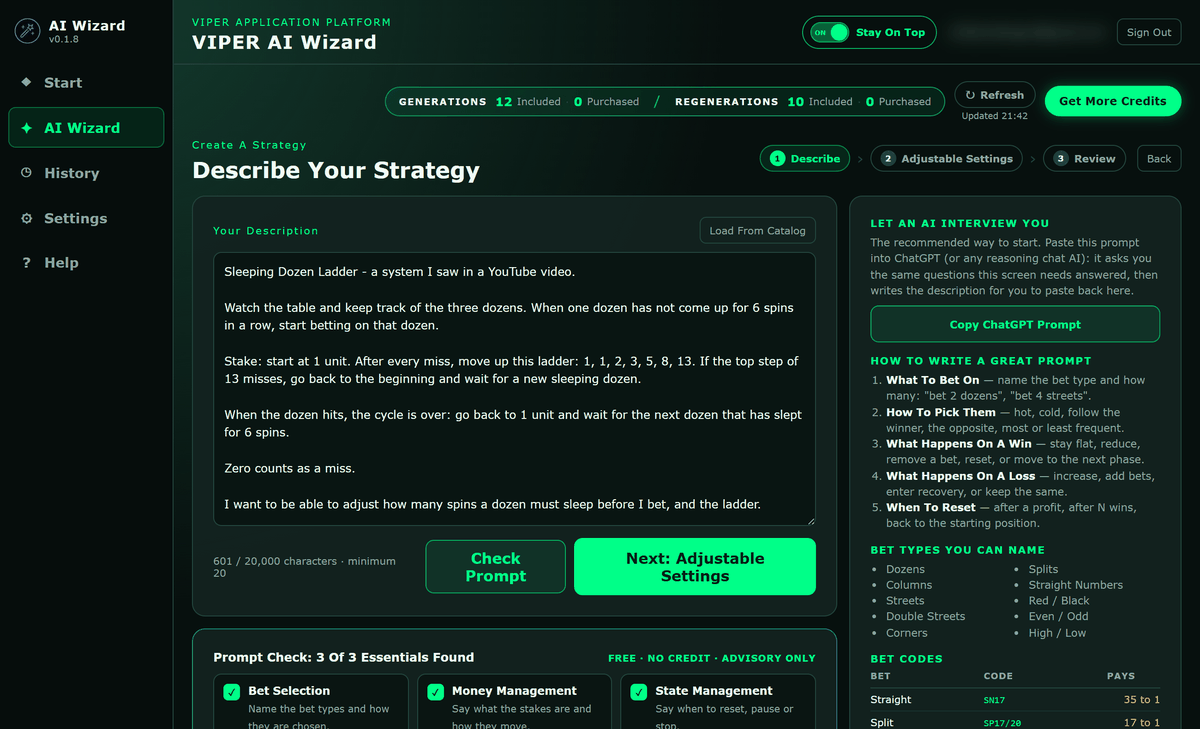
Open AI Wizard, press Create A Strategy, and look at the reference panel on the right. The first block is Let An AI Interview You, and under it a button: Copy ChatGPT Prompt.
Press it and the prompt goes to your clipboard — a toast says Copied — paste it into ChatGPT. Open ChatGPT, or any reasoning chat AI you already use, paste it in, and answer what it asks. (If your machine blocks clipboard access the button says so instead of pretending it worked, and you can select the text and copy it by hand.)
Two things worth knowing before you start. The interview costs you nothing — no credits, no generation; credits are only spent when you press Generate later. And the chat is entirely your own: it runs in your ChatGPT account, it cannot see VIPER, your balance or your session, and nothing reaches the Wizard except the text you choose to paste back.
What the interview actually does
The prompt is not a form. It sets rules for the AI, and they are the reason this works better than staring at an empty box:
- At most four questions per round, then it waits for your answers. No wall of twenty questions.
- Plain language only. It is told never to write code, formulas or variable names. It is collecting the rules of play, not a specification.
- It keeps going until it can state every rule without guessing. Vagueness is not accepted, it is queried.
- If you are vague it offers you two or three concrete choices. This is the part people are surprised by: you do not need to know the answer, you need to recognise it. "I don't know, you pick" is a legitimate reply, and so is picking the middle option because the other two sound wrong.
- European single-zero roulette, numbers 0 to 36, throughout.
The seven things it will not let you leave vague
It works through these in order. The list is worth reading on its own, because it is a decent audit of any system you already play.
| It asks about | What it is really pinning down |
|---|---|
| The idea, in one sentence, and a name | Whether the strategy is one idea or three tangled together |
| Bets | Which types, how many each spin, and how they are chosen: fixed, following recent winners, avoiding them, coldest, hottest, or a pattern |
| Stakes | The starting stake in units, what happens after a win, what happens after a loss, any cap on the ladder, and what happens when you reach it |
| When to start | From the first spin, after watching a number of spins, or on a trigger |
| When to stop or pause | Stop-loss, profit target, lock in profit once ahead, sit out after a run of losses — or none, since the session has its own |
| Resets | After a win, after a completed cycle, on a new profit high, or never |
| What you want to adjust later | Which numbers become dials you can turn between sessions |
Look at the stakes row and the resets row especially. In our experience those two are where a strategy someone has played for years turns out to have two possible readings, and the player has been quietly doing both.
What comes back
When it has everything, it prints your description between two markers:
===== PASTE INTO VIPER AI WIZARD =====
<Strategy name> - <one sentence idea>. European single-zero roulette.

Bets: ...
Stakes: ...
Start: ...
Stop or pause: ...
Resets: ...
Adjustable: ...
===== END =====
Copy everything between the markers — not the markers themselves — into Your Description, then read it. This is the step people skip and should not. It is your strategy, in plain English, and if a line is not what you meant, change it right there in the box. You are allowed to edit; the Wizard reads what is in the box, not what ChatGPT said.
Then press Check Prompt. It is free and instant, and it tells you whether the description covers the three things every strategy needs: what to bet, how the stakes move, and when to reset. A description that came out of the interview normally scores three out of three.
Then the Wizard builds it
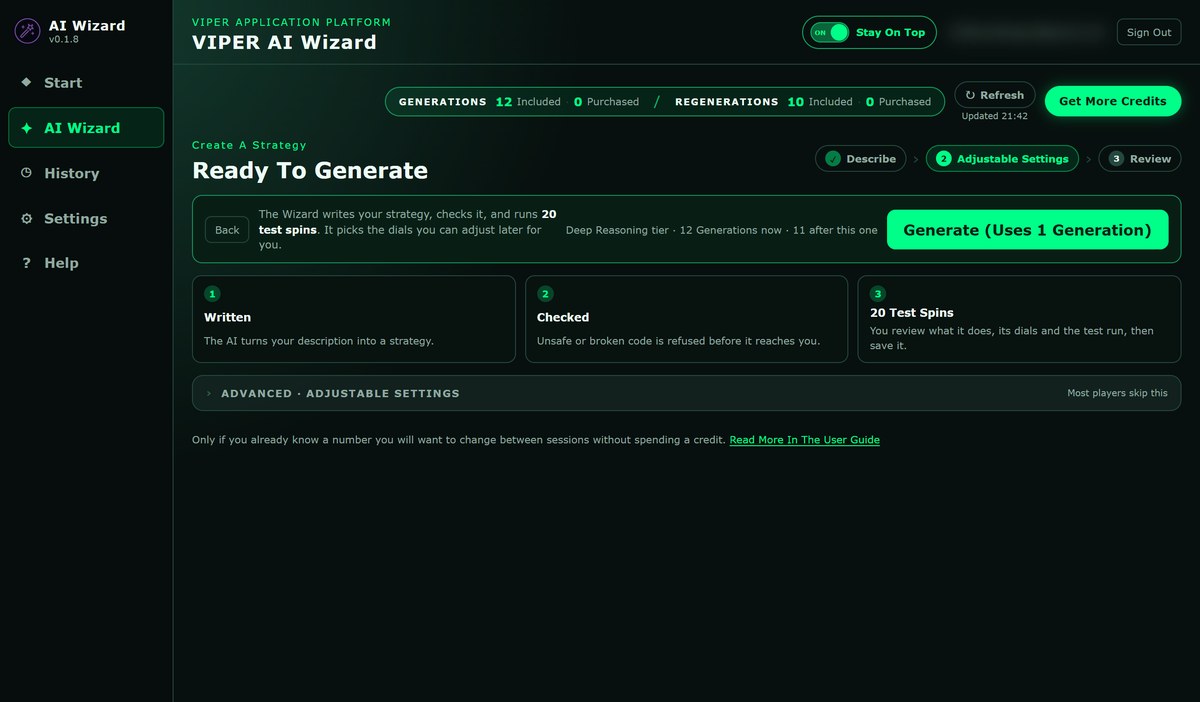
Generate is the only button in this flow that spends a credit. The strategy is written, it is checked — unsafe or broken code is refused before it ever reaches you — and it is run through 20 test spins. In our runs it took between 17 and 41 seconds.
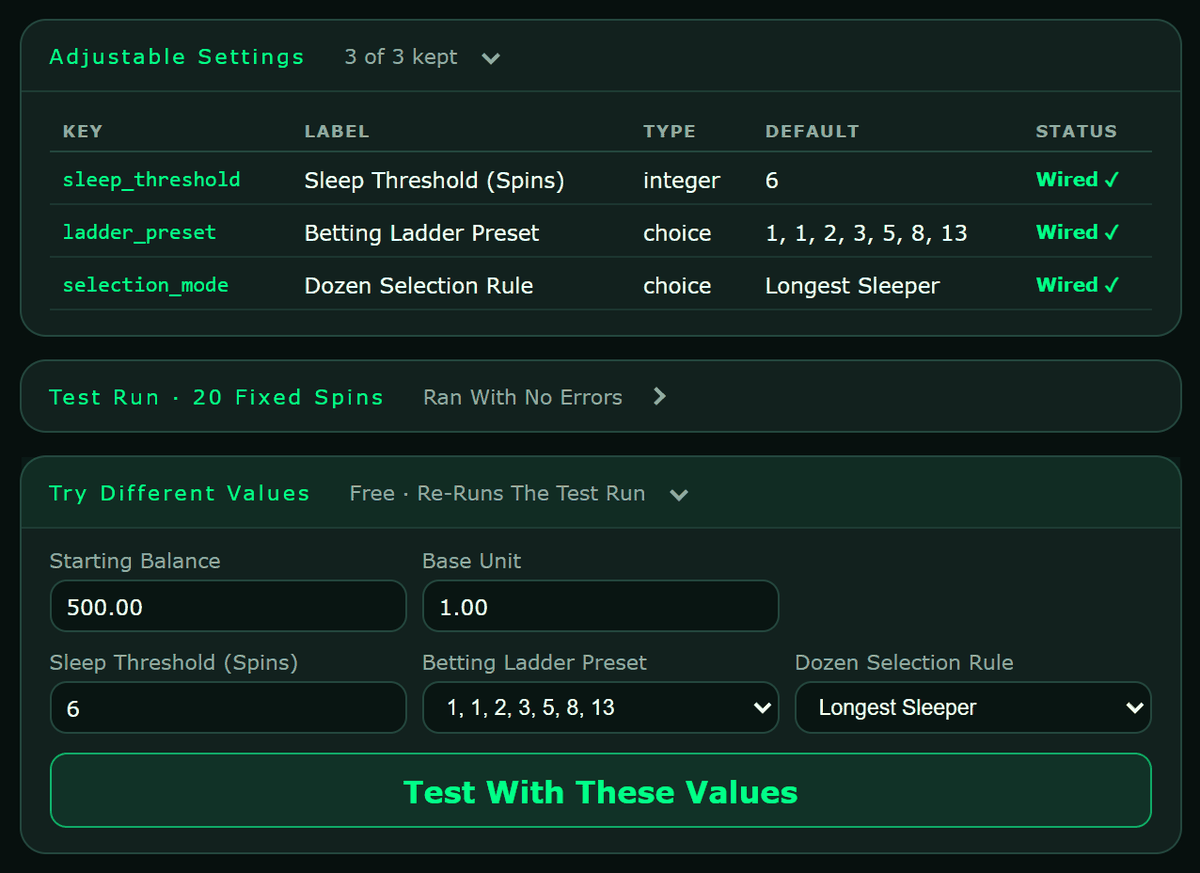
The Review screen tells you in plain sentences what it built, so you can hold it against what you asked for, and lists the dials. Each one is marked Wired: VIPER read the generated code and proved the strategy actually uses that setting. Anything the code ignores is dropped rather than displayed, because a dial that looks live but is not will one day show you one number while the strategy plays another.
Remember question seven in the interview — the numbers you said you wanted to adjust? This is where they turn up.
Then put it through its paces
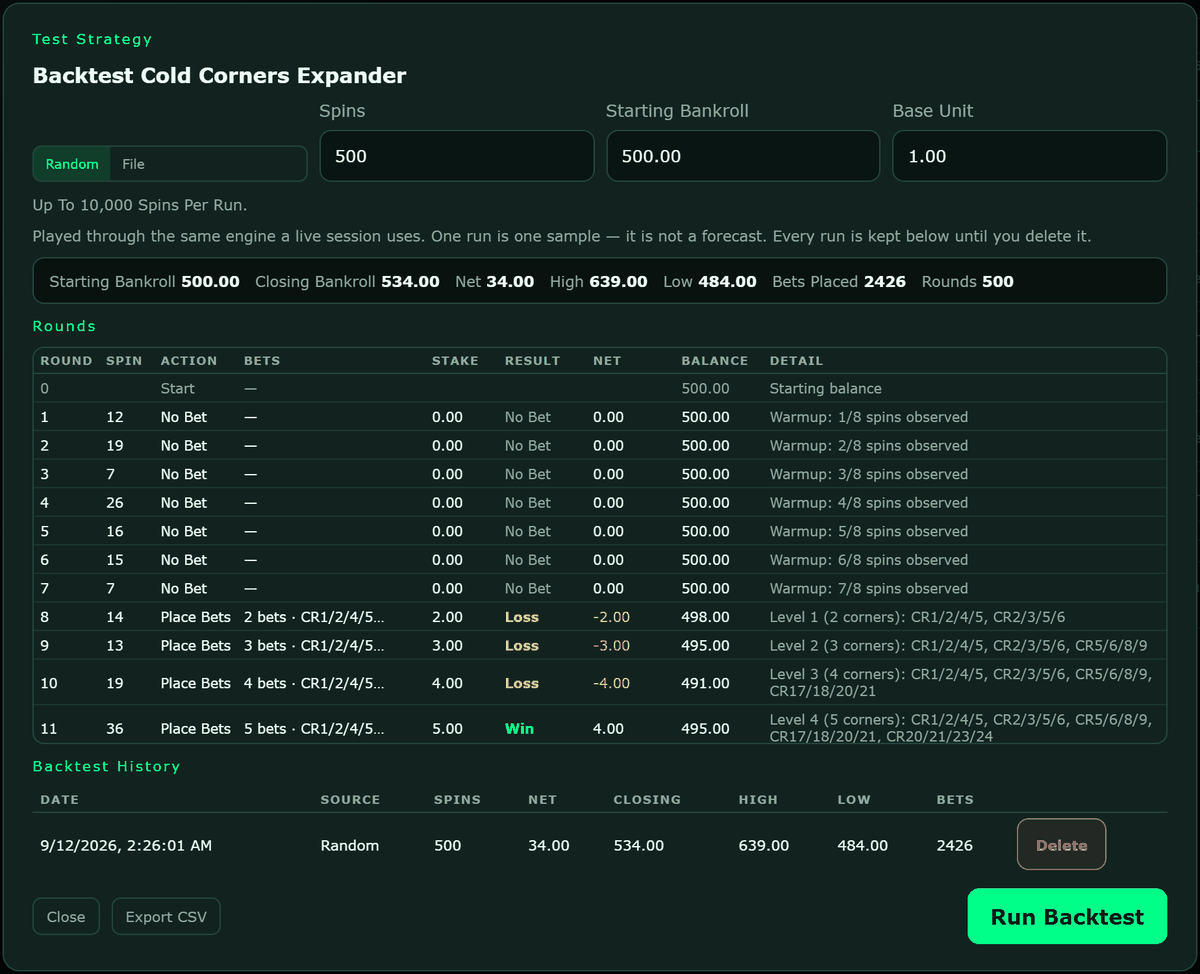
Test takes your new strategy over as many as 10,000 spins — random, or a spin file of your own — through the same engine a live session uses. It lists every round with what was bet and the balance after it, keeps each run in a history so you can compare settings, and exports the lot to a spreadsheet.
The run above is a cold-corners strategy over 500 spins: it opened with eight warm-up spins, widened its coverage each time it missed, and came out at $534 from $500, having been as high as $639 on the way. Read down the rounds and you can watch the mechanism work, level by level.
That is the real reward for doing the interview properly. A description tells you what your strategy will do; a few thousand spins show you what it does — how it moves, how long its runs go on, and how much bankroll it wants underneath it. One run is one sample rather than a forecast, so change a dial, run it again, and compare. Reading a backtest covers what to look at.
What the interview cannot do
It makes your idea complete. It does not make it good. A fully specified bad system is still a bad system, which is exactly why the backtest sits one click from everything you make.
It also cannot make the wheel remember anything. If your rule waits for a dozen to go cold, the interview will happily write that down, and it should — it is your strategy. But the trigger decides when you bet, never what the odds are. On a single-zero wheel a dozen still misses 25 times in 37 whatever it did last.
And every strategy the Wizard writes plays against the same 2.70% as everything else on the table. Over a short session that edge is small next to the swings, and the swings are what the limits on the Start screen are for: set a profit target and a stop loss every time, because a generated strategy has none of its own.
Bring the one you have been carrying around
If you follow the roulette channels — Bet With Mo, The Roulette Master, any of the dozens of others — you have watched somebody walk a system through fifty spins and thought I would play that differently. That thought is a strategy. It is just not written down yet.
Open the chat, paste the prompt, and answer four questions at a time until it hands you the description. Then let VIPER build it, test it over a few thousand spins, and find out what it actually does.
We have no affiliation with any channel named here, and nothing above is their endorsement of VIPER.
— Team Viper