The second most-watched video on The Roulette Master channel, at over half a million views, comes with a great story. A subscriber called Tony says he plays online for about two hours a day with $1 bets and a $231 bankroll, and makes between $60 and $75 an hour from home. His system goes head to head with a classic, Triple Martingale. In fifteen minutes each on camera, Triple Martingale made 40 units and Tony's system made 35.
I rebuilt Tony's system click by click in the VIPER Survival Lab, our free roulette risk calculator, and ran 10,000 normal 30-spin sessions. The results explain why Tony is happy with it, and they hold two surprises. The first is about the column switching Tony says is the secret. The second, as so often, is in the bankroll. Every number below comes from the lab, and the link at the end reopens the exact setup.
Only gamble with money you can afford to lose.
What Tony's system is
Two columns, one unit each. In the video a unit is $1.
- $1 on two columns, never the first and third together. So it's always either the first and second, or the second and third.
- Win: stay on the same two columns and go back to $1 each.
- Loss: triple both bets and switch to the other pair. Each bet goes $1, $3, $9, $27, and so on.
A column pays 2 to 1, so a winning spin returns $3 for the $2 on the table: +$1. A loss costs both bets. Tony's reasoning is that losing several times in a row means the ball has to bounce from the first column to the third and back again, over and over, and he doesn't see that often.
Step 1. Build the layout
Open the lab on the 01 Build layout tab.
- Leave the wheel on EU · single zero. The only zero in the video is a single one.
- Pick the $1 chip.
- Tap the 2 to 1 box at the end of the middle row (2, 5, 8 and so on) and the one at the end of the top row (3, 6, 9 and so on). That's $1 on the second column and $1 on the third.
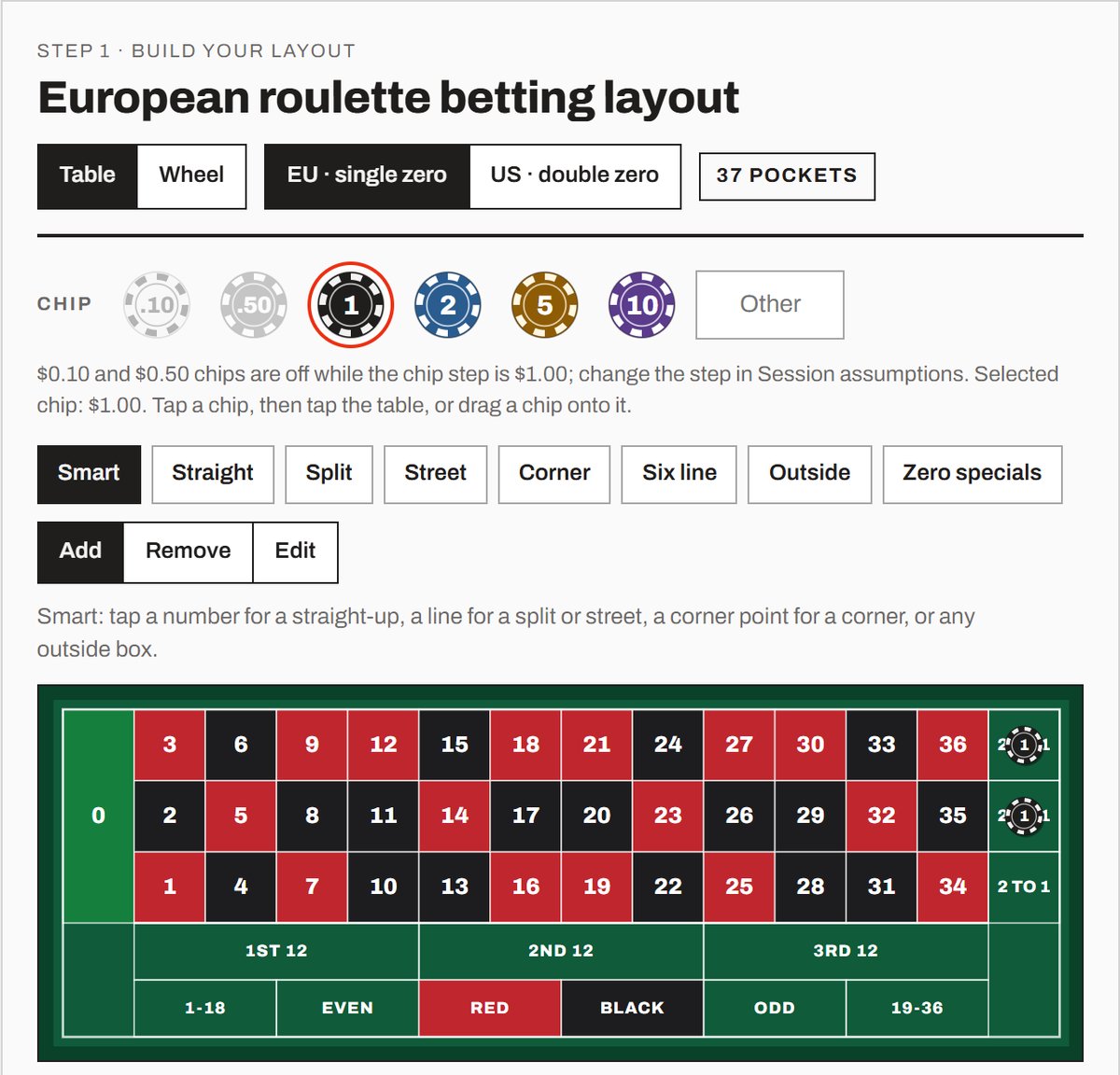
The Your layout panel shows the shape at once: $2 at risk, 24 of 37 pockets win $1, 13 lose $2. No pushes at all.
Step 2. Set the bankroll and the ladder
Open Session assumptions on the left.
- Bankroll 231. Chip step $1.00. Spins in session 30, a normal sitting.
- Leave Profit target and Stop-loss at None for now.
Under Progression, set Type to Custom ladder and leave Applies to on Whole layout. Tripling gives these multipliers, entered one at a time with Add level: ×1, ×3, ×9, ×27, ×81, ×243.
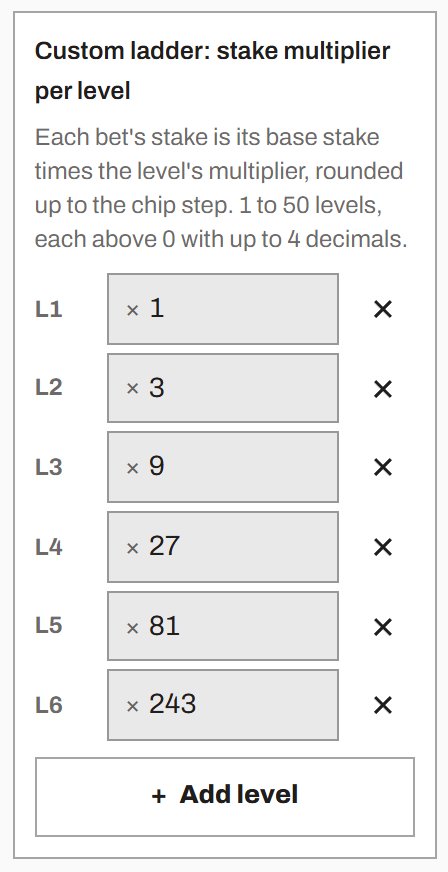
Then the rules: After a net loss, Step up 1 level. After a net win, Back to Level 1. Every spin here is a win or a loss, so the push rule never comes into play.
You'll notice there is no setting for "switch columns". That's on purpose, and it is the first surprise.
Surprise one: switching columns changes nothing
Tony's whole system rests on where his chips sit. The wheel doesn't know where they are. On every spin, two columns cover 24 numbers and lose on the other 12 plus zero, whichever two you pick. A move to the other pair after a loss doesn't change the chance of the next spin by a hair.
The bounce from first column to third that Tony rarely sees has the same odds as any other way of losing: 13 numbers in 37, every spin. So I ran the same 10,000 sessions three ways:
| 30 spins, seed tony | Columns 2 and 3 | Columns 1 and 2 | Triple Martingale on two dozens |
|---|---|---|---|
| Sessions that finished ahead | 78 in 100 | 78 in 100 | 78 in 100 |
| Median session | +$18 | +$18 | +$18 |
| Next bet couldn't be placed | 18 in 100 | 19 in 100 | 18 in 100 |
The differences are just the luck of individual spins. Tony's system and Triple Martingale are the same bet in different clothes: two-thirds of the wheel, $1 to win, triple after a loss. That is why the two halves of the video looked so alike, finishing on 40 and 35 units.
Step 3. Read the analysis
Press Analyze risk.
Every win is worth exactly $1
The recovery map shows the deal a martingale makes. However deep the run goes, a win puts you back where you started, plus $1.
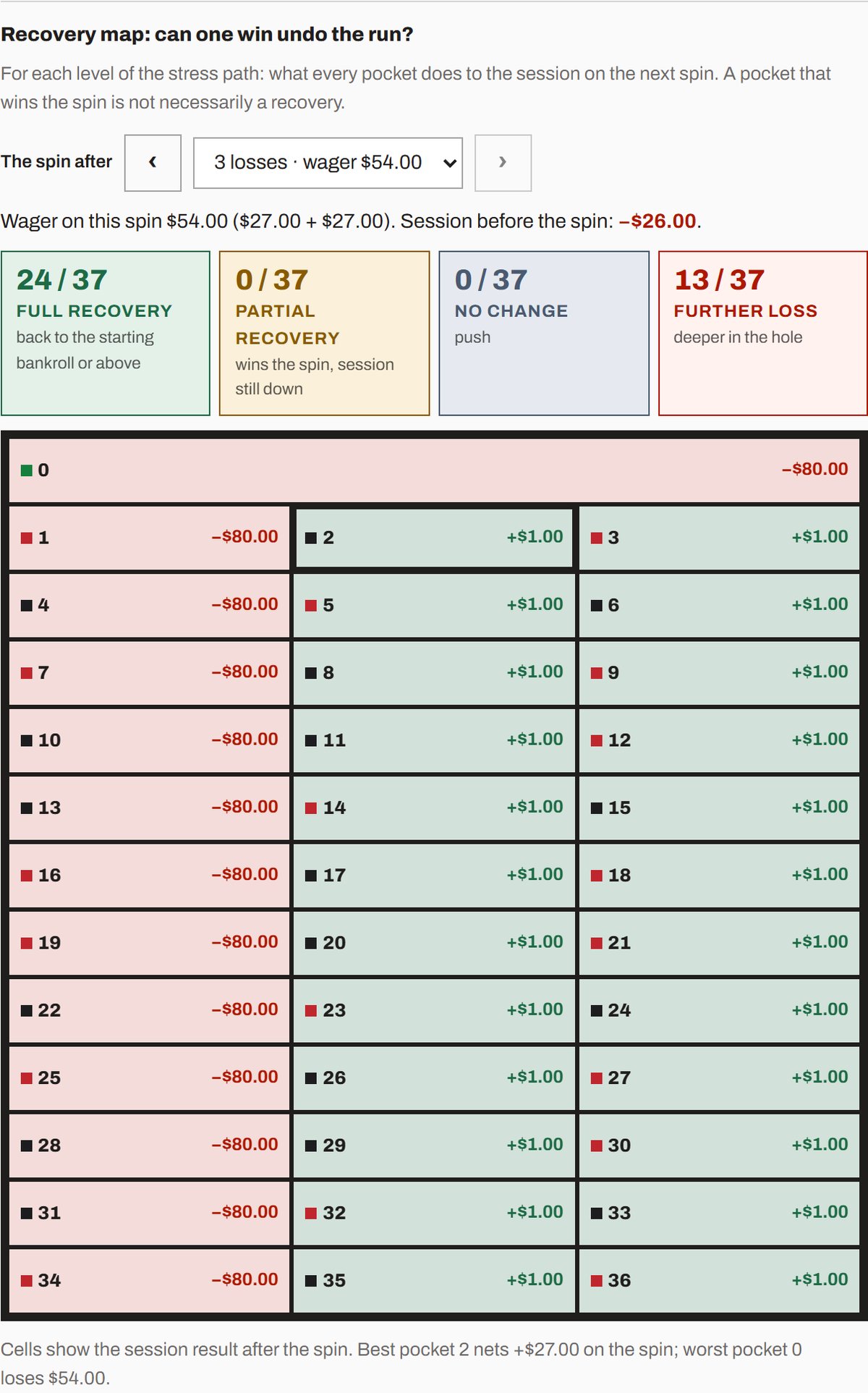
| Losses before the win | Bet on the winning spin | Run result |
|---|---|---|
| 0 | $2 | +$1 |
| 1 | $6 | +$1 |
| 2 | $18 | +$1 |
| 3 | $54 | +$1 |
That's the comfort of the system, and the catch. After three losses you're putting $54 on the table to win back $26 and make a dollar.
Surprise two: $231 covers four losses, not five
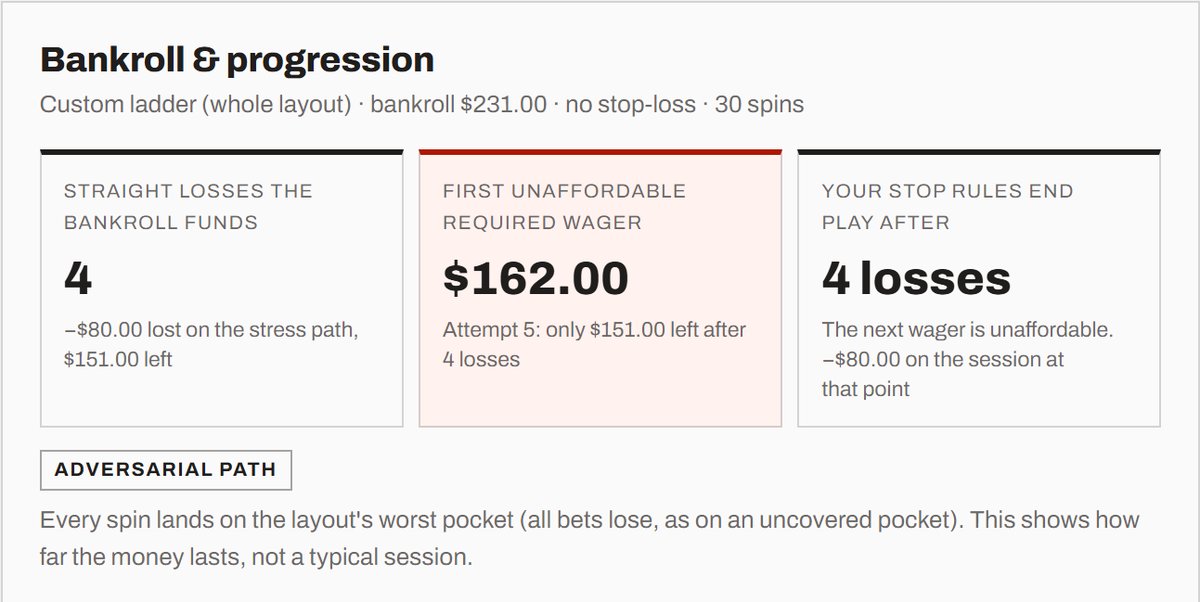
| Attempt | Bet on the spin | Lost so far | Bankroll after |
|---|---|---|---|
| 1 | $2 | $2 | $229 |
| 2 | $6 | $8 | $223 |
| 3 | $18 | $26 | $205 |
| 4 | $54 | $80 | $151 |
| 5 | $162 | not enough |
The fifth rung needs $162, and four losses leave $151. You can only place it if you're already $11 up on the night. The Losing streaks section says how often four in a row arrives:
| Losses in a row | Chance within 30 spins |
|---|---|
| 3 | 59% |
| 4 | 25% |
| 5 | 9% |
One session in four sees four losses in a row somewhere. That's the column bounce Tony says he rarely sees.
Step 4. Run 30-spin sessions
Press Run sessions, type tony as the seed, choose 10,000 sessions and press Run.
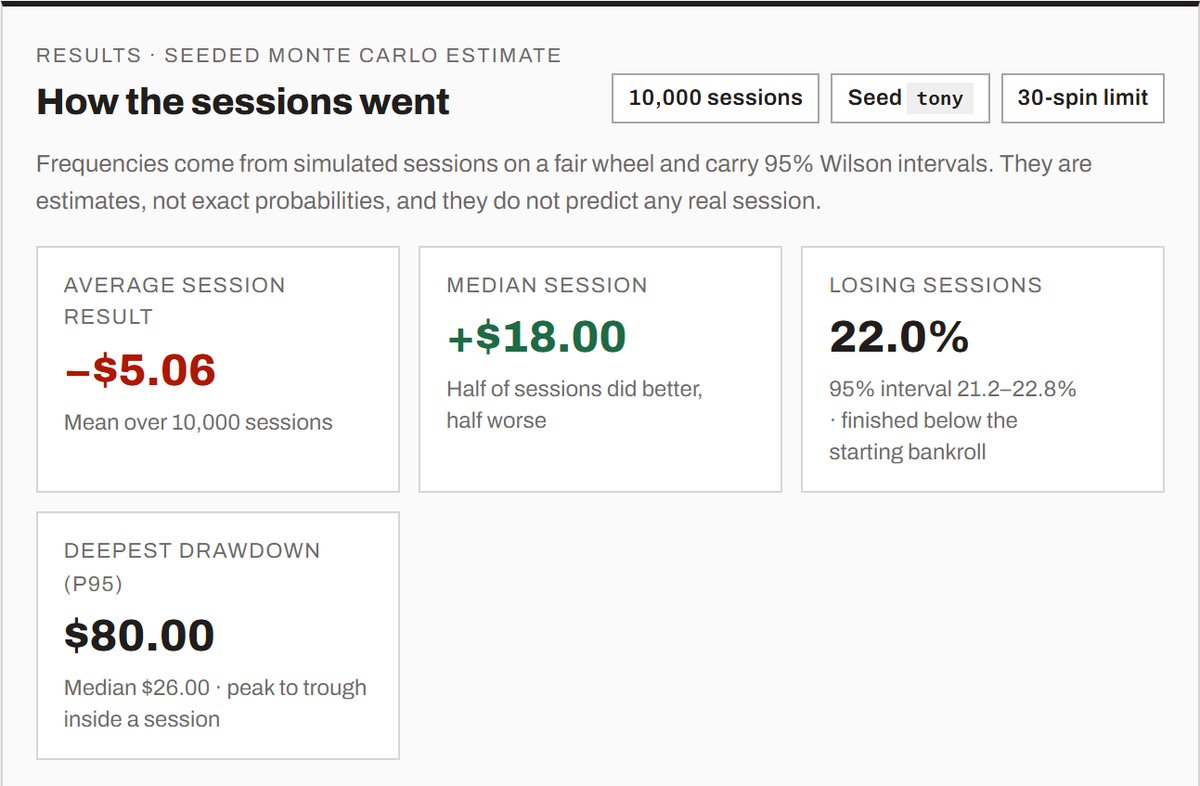
| One 30-spin session | |
|---|---|
| Sessions that finished ahead | 78 in 100 |
| Median session | +$18 |
| The middle half of sessions | +$11 to +$21 |
| Best session | +$28 |
| Sessions where the next bet couldn't be placed | 18 in 100 |
| Worst session | −$231 |
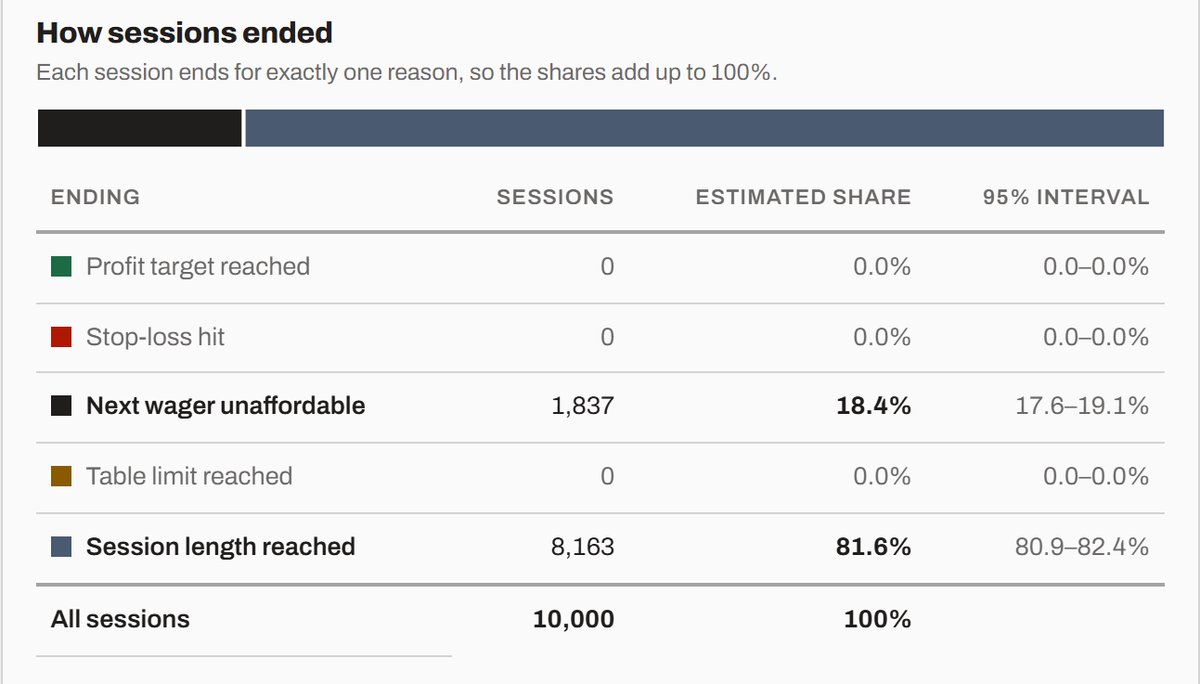
Now Tony's story makes sense. Almost eight sessions in ten are winners, and the typical one collects $18 in 30 spins, a dollar at a time. Play fast online and string enough of those together, and the hourly figure he quotes is just what the winning sessions look like.
The other side is just as plain. About one session in five runs into the fifth rung and gives back around $80 in one go, which is four or five good sessions' worth. That trade, many small wins against a rare bigger loss, is what every martingale is built on. Triple Martingale made 40 units in its fifteen minutes and Tony's system 35, both from many more than 30 spins. In 30-spin sessions, the best of 10,000 was +$28.
Two settings worth trying
A profit target. Put Profit target at $20 and run again. The share of sessions that finish ahead edges up to 79 in 100, and the session stops while it's ahead. It doesn't change the bad night much, though: the ladder still needs its fifth rung in about 18 sessions in 100. With wins arriving a dollar at a time, the target trims the good nights rather than protecting you from the bad ones.
The wheel. Flip the felt to US · double zero and the extra pocket matters: the next bet can't be placed in 22 sessions in 100 instead of 18, and the share ahead drops to 75 in 100. Tony plays online, where a single zero is easy to find. If you play his system, play it there.
Take it with you
Open Tony's system in the Survival Lab and every number above is live. Swap the columns for two dozens and watch the results stay put, add a profit target, or move to a double-zero table. The Run sessions tab replays the worst session spin by spin, and the Risk report tab prints the lot on one page.
Tony has found the part of roulette that suits him: tiny bets, a long night and a steady drip of dollars. The lab shows what that drip costs, which is about one night in five that gives it back, and that the column he leaves out never mattered. For the channel's most-watched system, see John B's roulette system.
We have no affiliation with The Roulette Master or Tony, and nothing above is their endorsement of VIPER.
— The Professor