The most-watched video on The Roulette Master channel, at over 900,000 views, is a head-to-head. A long-time favourite called Romanovski goes first, then a subscriber's system goes up against it: two even-money bets, a simple ladder, and a promise that you can "play all night long" and go home a winner. The subscriber is John B, and in fifteen minutes on camera his system made $920.
Here is what I did with it: rebuilt it click by click in the VIPER Survival Lab, our free roulette risk calculator, then ran 10,000 normal 30-spin sessions to see what a real night looks like. Some of it is better than you might expect. One part is a genuine surprise, and it is hiding in the bankroll. Every number below comes from the lab, and the link at the end reopens the exact setup.
Only gamble with money you can afford to lose.
What John B's system is
Two bets of one unit each. In the video a unit is $20, on a $2,000 bankroll.
- $20 on 1-18.
- $20 on Even.
Three things can happen on a spin:
- Both win when the ball lands on a low even number, 2, 4, 6 and so on up to 18. The spin nets +$40.
- One wins, one loses on a low odd number or a high even one. That is a break even, and with this layout it happens a lot.
- Both lose on a high odd number, 19, 21 and so on up to 35, or on zero. The spin costs $40.
The progression is one sentence: after a loss, double each bet and add one unit. So each bet goes $20, $60, $140, $300, and so on. A break even keeps the bet where it is. A win goes back to $20. John B says the same plan works on Odd and 19-36.
Step 1. Build the layout
Open the lab on the 01 Build layout tab.
- Leave the wheel on EU · single zero. Only a single zero ever appears in the video, and the double-zero numbers are at the end.
- Pick the $10 chip from the rack.
- Tap the 1-18 box twice and the Even box twice. Chips stack on repeat taps, so each reads $20.
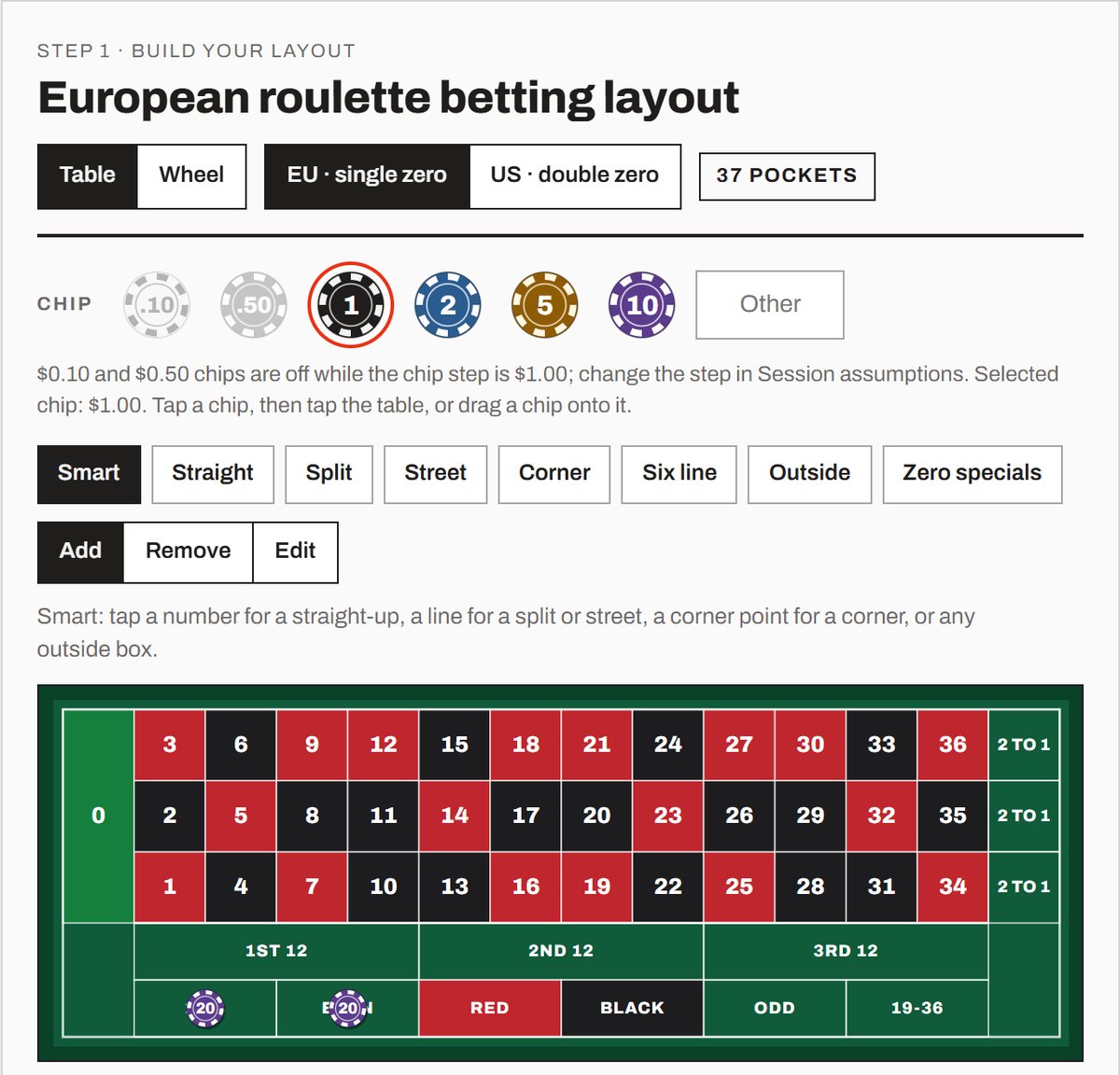
The Your layout panel sums it up at once: $40 at risk, 9 of 37 pockets win, 18 push, 10 lose. Half the wheel is a break even, which is exactly why the video is full of them.
Step 2. Set the bankroll and the ladder
Open Session assumptions on the left.
- Bankroll 2000. Chip step $1.00. Spins in session 30, a normal sitting.
- Leave Profit target and Stop-loss at None for now, the way the video plays it.
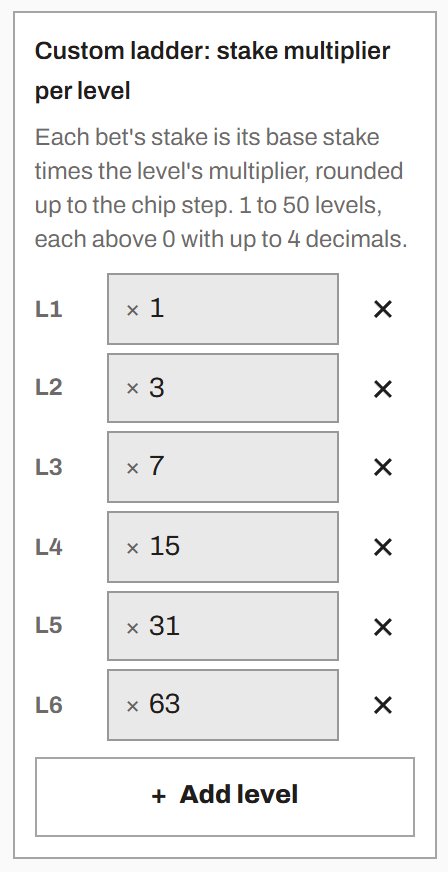
Under Progression, set Type to Custom ladder and leave Applies to on Whole layout. "Double and add a unit" gives these multipliers, so enter them one level at a time with Add level: ×1, ×3, ×7, ×15, ×31, ×63. On $20 that is $20, $60, $140, $300, $620 and $1,260 per bet.
Then the three rules under the ladder:
- After a net loss: Step up 1 level.
- After a net win: Back to Level 1.
- After a push: Stay on this level.
Last, under Losing streaks, choose Net losses, pushes ignored. A break even never moves John B's bet, so it shouldn't break a losing run either.
Step 3. Read the analysis
Press Analyze risk.
The good news: every win recovers the run
Most progressions only claw back part of a bad run. The recovery map shows John B's does better than that, and the "add a unit" part is the reason. A win at any rung pays back everything lost on the way up, plus a profit that grows with the rung.
| Losses before the win | Bet on the winning spin | Session after the win |
|---|---|---|
| 0 | $40 | +$40 |
| 1 | $120 | +$80 |
| 2 | $280 | +$120 |
| 3 | $600 | +$160 |
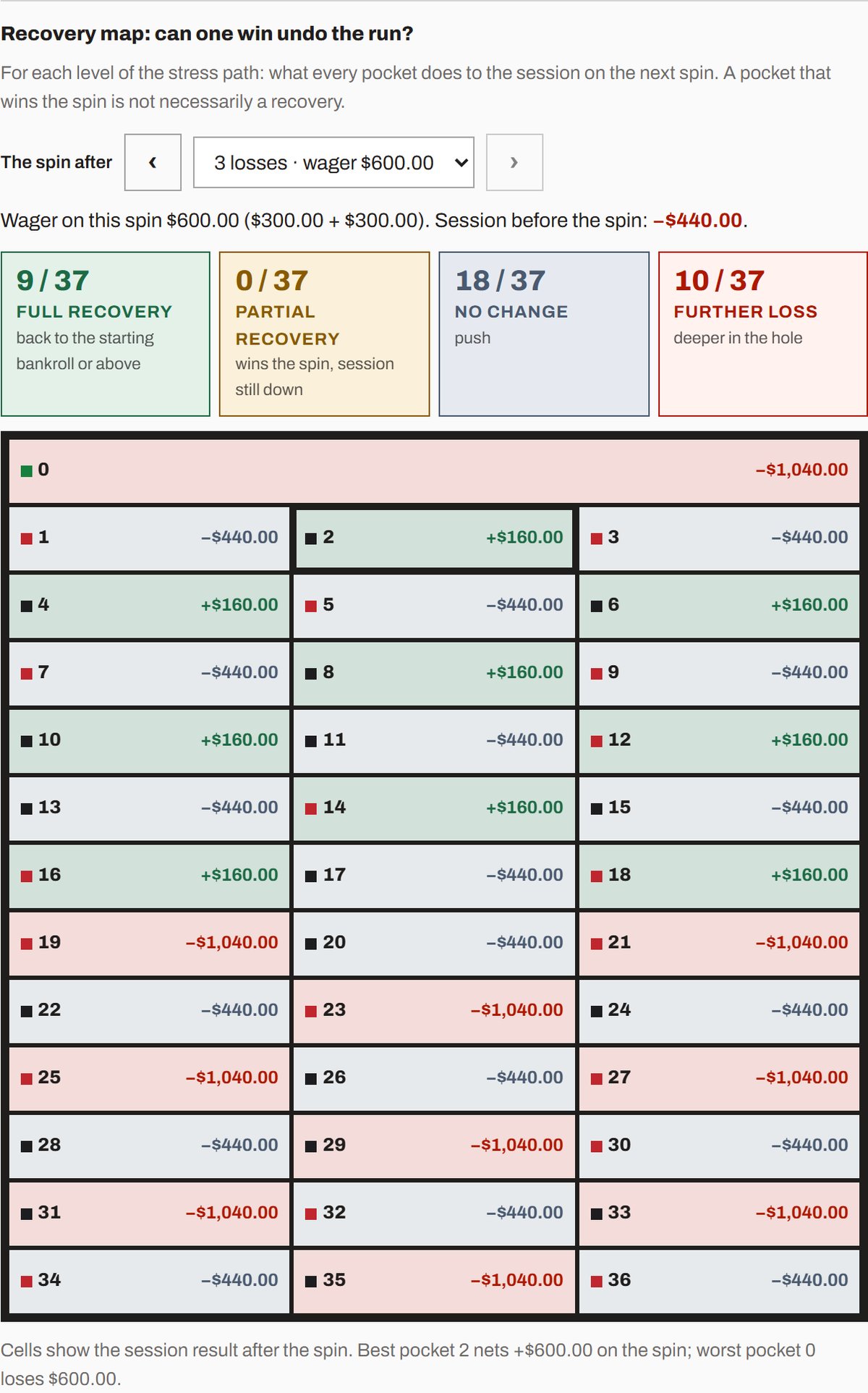
That is the engine behind the video's best moments: the "$600 win" at 21:02 and the "$280 wins" later on are exactly these rows.
The surprise: $2,000 funds four losses, not five
| Attempt | Bet on the spin | Lost so far | Bankroll after |
|---|---|---|---|
| 1 | $40 | $40 | $1,960 |
| 2 | $120 | $160 | $1,840 |
| 3 | $280 | $440 | $1,560 |
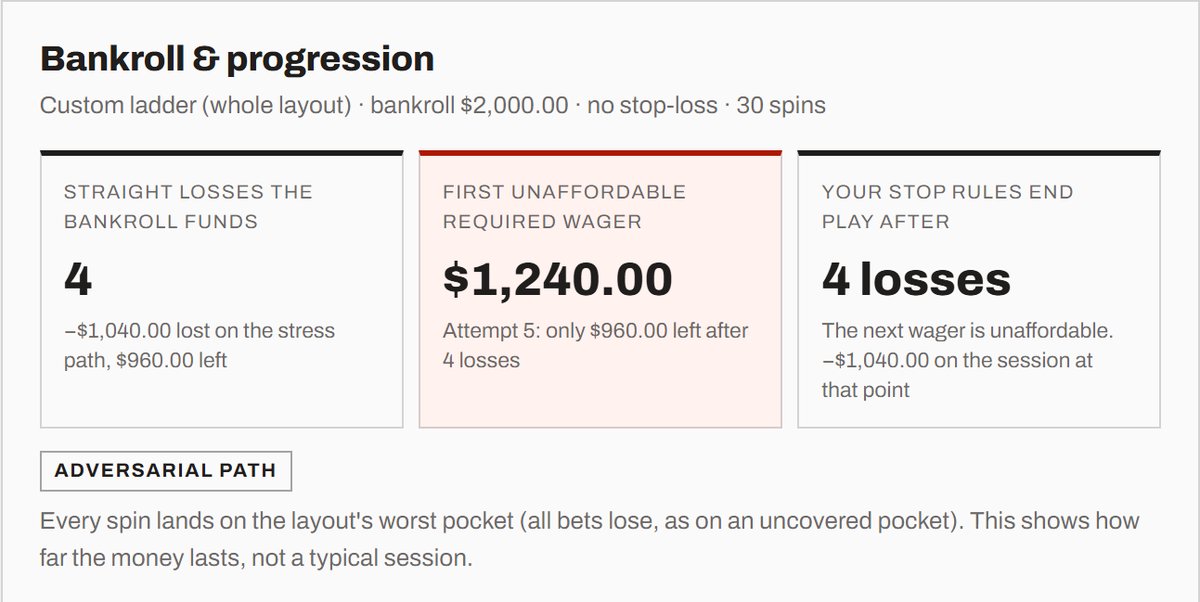
| 4 | $600 | $1,040 | $960 |
| 5 | $1,240 | not enough |
A $2,000 bankroll sounds like a lot of cover for $20 bets. But the ladder grows faster than it looks, and the fifth rung, $620 on each bet, can't be placed. After four losses the run is over unless you are already at least $280 up on the night.
How often does that happen? The Losing streaks section answers it exactly. Because a break even doesn't end a run, a "four in a row" can stretch across many spins:
| Losses in a row | Chance within 30 spins |
|---|---|
| 3 | 73% |
| 4 | 44% |
| 5 | 23% |
Nearly half of all 30-spin sessions see four losses in a row somewhere.
Step 4. Run 30-spin sessions
Press Run sessions, type john-b as the seed, choose 10,000 sessions and press Run.
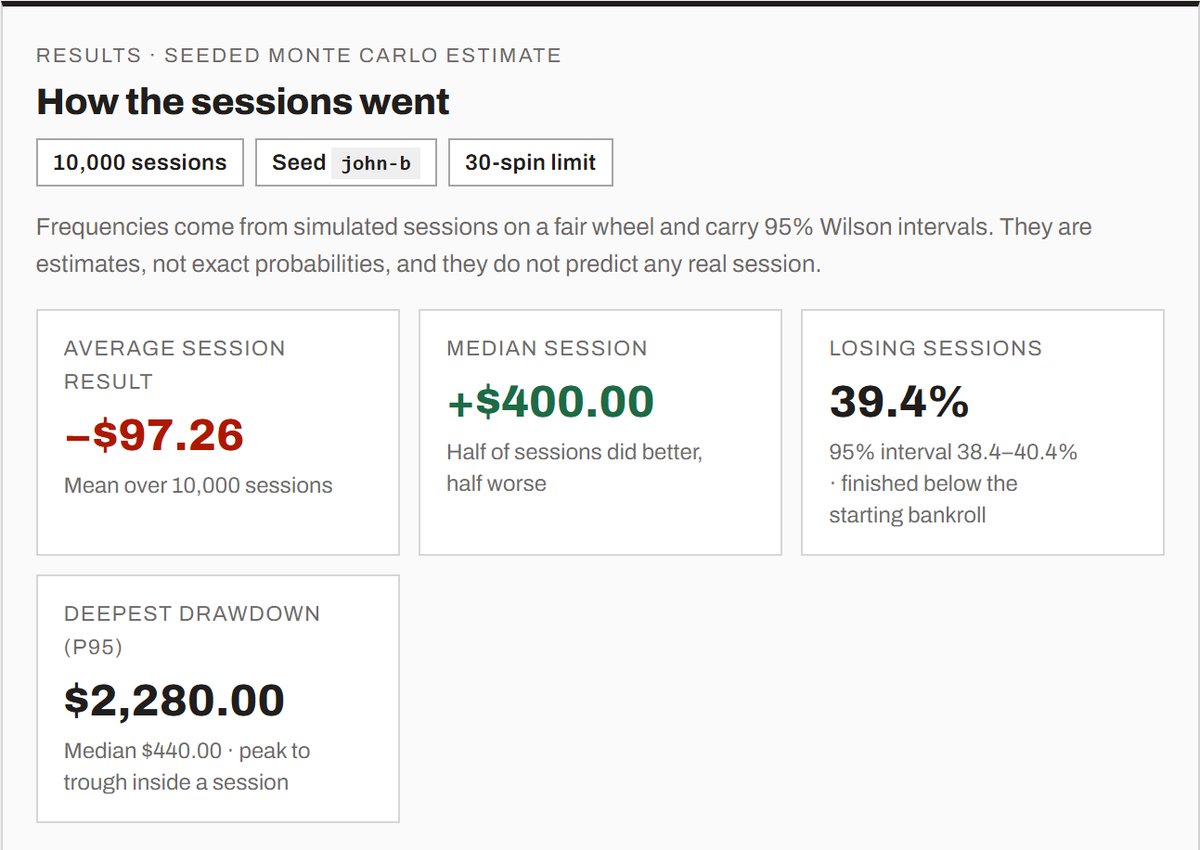
| One 30-spin session | |
|---|---|
| Sessions that finished ahead | 60 in 100 |
| Median session | +$400 |
| Best session | +$1,040 |
| Sessions where the next bet couldn't be placed | 35 in 100 |
| Sessions that finished $1,000 or more down | 18 in 100 |
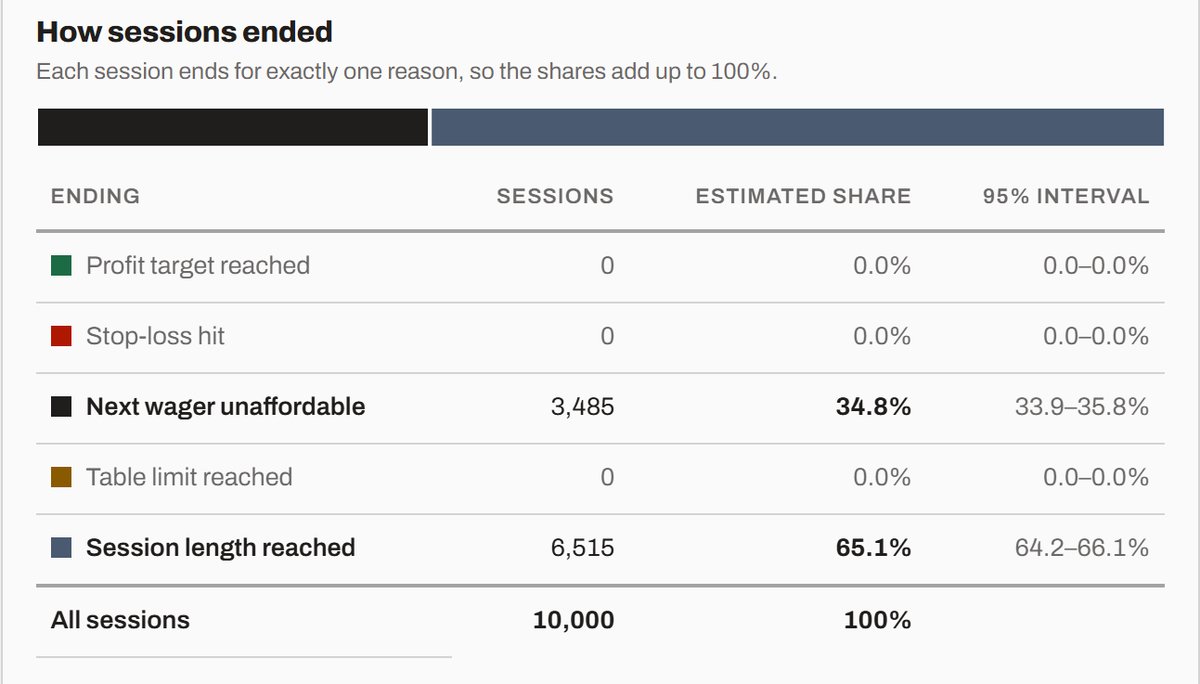
Both halves of the video's story are true at once. The typical night is a good one: six sessions in ten finish ahead, and the middle one is $400 up after just 30 spins. That's the system you watched.
The other third of the nights end on the fifth rung. That is how this kind of ladder works: lots of small wins, paid for by a rare big loss, and here the "rare" loss comes round about one night in three. John B's $920 came from about 60 spins of play. Across 10,000 sessions of 30 spins, the best finish was $1,040, and 10 sessions reached $920.
Two settings that change the night
Take John B's own advice. Twice in the video he says to cash out when you're up. Put a Profit target of $200 in Session assumptions and run again:
| 30 spins, seed john-b | As played | With a $200 target |
|---|---|---|
| Sessions that finished ahead | 60 in 100 | 78 in 100 |
| Median session | +$400 | +$200 |
| Biggest bet ever placed | $1,240 | $600 |
| Worst session | −$2,000 | −$1,040 |
Leaving at +$200 turns six good nights in ten into nearly eight, and the worst night stops at four rungs. It is the same trade in a calmer shape: a likely $200, and 22 sessions in 100 that end $1,040 down. You choose it before you sit down.
Check your wheel. Flip the felt to US · double zero and 00 joins the losing numbers. Over 30 spins the next bet can't be placed in 40 sessions in 100 instead of 35, and the sessions that finish ahead drop to 55 in 100. If your table has a single zero, play it there.
One thing the lab doesn't model: John B mentions a variation where a zero doesn't count as a loss for the ladder. The lab treats zero like any other losing spin, which is how he played it in the video.
The warm-up act: Romanovski
The first half of the video is Romanovski, an old favourite: $60 on the second dozen, $60 on the third, and $20 on each of two corners in the first dozen. The video doesn't say which corners, so I used 1/2/4/5 and 8/9/11/12. Rebuild it the same way and the lab shows its shape straight away. 32 of 37 numbers win $20, and 5 lose $160. One loss costs eight wins.
Played flat for 30 spins, Romanovski finished ahead in 41 sessions in 100, with a median of −$120. Two losses in a row turned up in 38% of sessions. It made $440 in its fifteen minutes on camera. In 30-spin sessions, 1 in 80 got there.
Take it with you
Open John B's system in the Survival Lab and every number above is live. Add the $200 target, try Odd and 19-36 instead, or scale the whole thing down to $2 bets and a $200 bankroll, as the video suggests. The shape stays the same at any size. The Run sessions tab replays the worst session spin by spin, and the Risk report tab prints the lot on one page.
John B's system is better than most YouTube ladders: every win really does bring the run back, with interest. Its weak spot is just how deep the ladder goes on $2,000, and now you know exactly where that is before the first chip goes down. The channel's next most-watched system gets the same treatment in Tony's two-column roulette system.
We have no affiliation with The Roulette Master or John B, and nothing above is their endorsement of VIPER.
— The Professor