You have a favourite strategy. It banks small, it leaves early, it is ahead more sessions than not.
Now imagine it had a partner — a second strategy on a different part of the layout, playing the same spins, whose ups and downs rarely line up with its own.
VIPER can run several strategies on the same spins at the same time. Each keeps its own ladder, its own targets and its own stop. Your session goal and stop loss sit above all of them. Most roulette tools cannot do this at all — and it turns out the right partners make a session steadier and reach the goal more often.
Four of the best pairs and our favourite stack are below. The full list — all 10 recommended pairs and 3 tested stacks — is for VIPER subscribers.
The partners that work
We ran every one of VIPER's 114 strategies through 2,400 sessions of 60 spins of real recorded wheel results and tested every pair: 6,441 of them. We picked the best on half the sessions, locked the list, and replayed them on the other half. 34 of the 40 locked pairs did it again. By chance, you would expect about 2.
Here are four of them:
played together each strategy alone, same total stake
| Pair | Stake ratio | Reached the goal (together / alone) | Session swing, lower = steadier (together / alone) |
|---|---|---|---|
| Dozens Done Dirty + Heat Seeker | 3.6 : 1 | 84 / 72 / 73 | 25 / 39 / 36 units |
| Last Out + Quadrants | 1 : 3.3 | 80 / 73 / 70 | 77 / 122 / 101 units |
| Column Repeater + Probability Press | 2.4 : 1 | 79 / 72 / 69 | 6.0 / 6.6 / 9.7 units |
| Probability Press + Quadrants | 1.5 : 1 | 78 / 69 / 70 | 15 / 24 / 20 units |
All four reached the goal more often than either strategy alone, swung less from session to session, and had a smaller downside, with the same total stake. Session swing is how far a typical session strays from the average — lower is steadier.
Three is where it gets interesting: the hit-and-run stack
Give your strategy two partners — three quiet strategies that win small, rarely bust, and bet on different parts of the layout — and when one hits a rough patch, only a third of your stake is in it. We call it a hit-and-run stack, and on sessions they had never seen, 22 of the 28 locked-in stacks we could compare beat every two-strategy mix of their own members.
Our favourite: Dozens Done Dirty + Expanding Zone + Factor 3 Dozens, staked about 12 : 4 : 1.
| Same total stake, same goal and stop | Reached the goal | Largest bet on one spin | Downside: worst 1 session in 20 (played to spin 60) |
|---|---|---|---|
| The stack | 80 | 22.5 units | -39 units |
| Dozens Done Dirty alone | 72 | 54 units | -90 units |
| Factor 3 Dozens alone | 72 | 57 units | -56 units |
| Expanding Zone alone | 47 | 14 units | -29 units |
More goals reached than either of its two headline strategies, a smaller downside, and a biggest single bet less than half the size. The reason is simple and measurable: the three strategies' losing streaks almost never coincide (all three were down together on 20.7% of spins — what three separate tables would give). And the partner doing the heavy lifting is Expanding Zone, which on its own finished ahead in only 13 of 100 sessions when played to spin 60 without a goal.
Alone, it looks like the worst strategy in the room. In the stack, it is the one keeping everyone steady.
Before you switch it on
The combinations work by smoothing out the swings, and that has a price worth knowing:
- Wins are smaller. A stack is built to bank a small goal and leave. Played to spin 60 without a goal, the stack above had a typical result of +5 units, against +36 for Dozens Done Dirty alone.
- The stop still costs more than the goal. Set the goal and stop before you sit down and let VIPER hold you to them.
- Choose from the list. Two strategies picked at random mostly just make a session calmer. The ones above, and the rest of the subscriber list, are the ones that held up — that is what the 6,441 pairs and 3,799 trios we tested were for.
- Nothing changes the table. Every unit still costs the same 2.70% on a single-zero wheel; what the right combination changes is where the losses fall.
- Keep them all running. Pausing one strategy halfway up its ladder, or accepting the Strategy Advisor's switch (which turns every other strategy off), breaks the combination.
- Try it small first. These are measured results on real recorded wheel results, not a promise about your next session.
Setting up your first stack
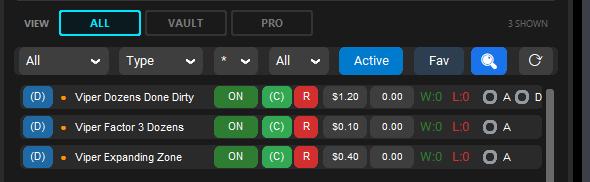
- Switch on each strategy in the Strategy Manager. They all play every spin together.
- Set each one's base unit with the small button on its row, in the ratio from the table. For the stack above, 12 : 4 : 1 works — for example $1.20, $0.40 and $0.10 (round each to your table's chip).
- Set one session goal and one stop loss. VIPER watches the combined balance and ends the session for all of them the moment either is hit. At those stakes, about $85 covered the stack in 99 sessions out of 100, the goal is about $4.20 and the stop about $42. Scale all three units together for bigger numbers.
- Leave each strategy's own settings as shipped — that is how every combination here was tested.
Three strategies, three sets of rules, one exit — enforced on every spin. That is automated discipline, applied to a whole team of strategies at once.
The full list is for VIPER subscribers: all 10 recommended pairs and 3 tested three-strategy stacks, with the stake ratio for each — so you can switch them on without doing the research yourself. See the plans.
— Team Viper