Everyone who has run a recovery ladder knows the round where it stops being a plan.
You are four steps in. The next step is bigger than the last three put together, and the arithmetic that made sense at step one — one hit and I am back — is now asking you to put a quarter of your night on the table to get back to even. You either place it, or you walk away from the money you have already spent trying to get it back.
That round is where most systems actually do their damage, and it is the round Three Moving Corners is built to never reach.
The idea in a paragraph
Three corners, one inside each dozen. A corner is four numbers, so three of them cover 12 of the 37 pockets — just under a third of the wheel. A corner pays 8:1, so when one of your three lands you collect nine chips on the winner and lose the two chips sitting on the other two corners. Put one chip on each corner and a hit is +6 chips, a miss is -3 chips, and the wheel gives you a hit 12 times in 37.
That is the whole bet. Everything interesting in this strategy is what happens to the stake after a miss.
How it actually plays
Play runs in cycles. A cycle opens with an empty ledger, picks three fresh corners, and tries to finish a few chips up. When it does, it closes and a new one starts. Two numbers govern it, and both are in chips:
- Cycle Target — 3 chips by default. How far ahead the cycle has to finish to count as won.
- Cycle Allowance — 48 chips by default. The most that cycle may ever put at risk, counted across every round it plays.
The allowance is the whole idea. It is not a stop loss that fires when you are down; it is a budget declared before the first chip, and the ladder is simply not allowed to spend past it.
Between those two, the Recovery Style picks each round's stake. The default, Planner, solves the question exactly: given what this cycle already owes and what is left of its allowance, which stake gives the best chance of closing at the target before the money runs out?
Here is that planner walking a genuinely bad cycle — seven straight misses, printed from the shipped code at the shipped defaults:
| Round | Owed | Spent | Stake each | Round costs | Aiming at | P(cycle closes green) |
|---|---|---|---|---|---|---|
| 1 | 0 | 0 | 1 | 3 | one hit | 87.8% |
| 2 | 3 | 3 | 1 | 3 | one hit | 82.0% |
| 3 | 6 | 6 | 2 | 6 | one hit | 73.3% |
| 4 | 12 | 12 | 1 | 3 | two hits | 60.5% |
| 5 | 15 | 15 | 3 | 9 | one hit | 55.9% |
| 6 | 24 | 24 | 2 | 6 | two hits | 34.7% |
| 7 | 30 | 30 | 6 | 18 | one hit | 32.4% |
After round 7 the cycle owes 48 chips, has spent its entire allowance, and no stake fits. It is parked.
Two things in that table are worth stopping on.
The stake does not climb monotonically. Rounds 4 and 6 go down. At those points the planner has worked out that it can no longer afford a stake big enough for one hit to clear the hole, so it downshifts to a cheaper stake that needs two hits instead — and buys itself more rounds with the money saved. Nobody programmed a "downshift when deep" rule. It falls out of the solve.
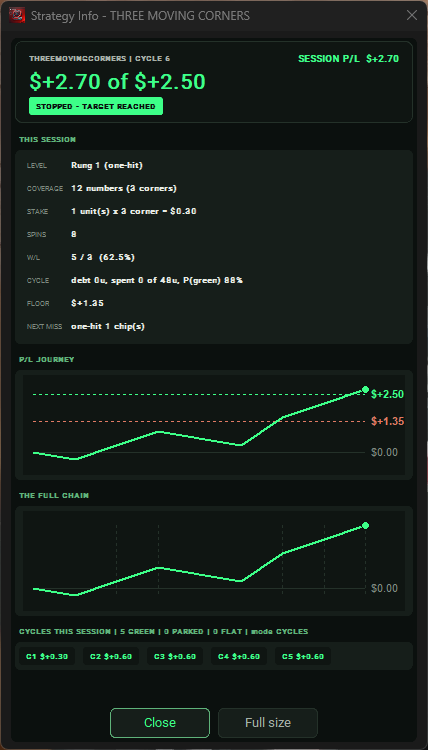
The honest number is printed on every round. That last column is the strategy's own estimate of its chances, and it does not flatter itself: a fresh cycle is 87.8%, and by round 7 it is telling you 32.4%. The screenshot above shows the same figure live — P(green) 88% on a fresh ledger.
Parking, and what it does not do
When no stake fits, the cycle does not take one last swing. It parks: the outstanding 48 chips are written to a parked pile, the ledger is wiped, and a completely fresh cycle starts on new corners at a 1-chip stake.
Be clear about what has and has not happened. The money is gone. Those 48 chips left your balance round by round as they lost, and parking does not give any of it back — your session P/L is exactly what it was a moment before. What parking changes is the ladder: it refuses to let a bad cycle keep escalating, and it hands you back a 3-chip round instead of a 60-chip one.
The pile is then worked off rather than forgotten. While anything sits parked, every cycle raises its sights by the Parked Debt Bite — 3 chips by default — so each cycle aims at 6 chips instead of 3, and the whole profit of every green close is credited against the pile until it is clear. Grinding, deliberately, in bites. Not one heroic round.
Why this beats chasing, in chips
The same all-miss run, same 48-chip allowance, under the three shipped Recovery Styles:
| Recovery Style | Rounds before it parks | Biggest single round | Allowance used |
|---|---|---|---|
| Planner (default) | 7 | 18 chips | 48 of 48 |
| One Hit | 5 | 12 chips | 33 of 48 |
| Legacy +2 (the original ladder) | 4 | 21 chips | 48 of 48 |
The original 1, 3, 5, 7 ladder spends the identical budget in four rounds. The planner makes it last seven — three extra swings at the same wheel, for the same money, with a smaller worst round.
That shows up over a night as a grind rather than a lurch. Across 3,750 sessions of 60 spins at the shipped settings, the planner closed 7 cycles green for every 1 it parked. The legacy ladder managed about 4 to 1, because it spends its allowance so fast it plays half as many rounds.
What 100 sessions look like
Shipped defaults — Planner, target 3, allowance 48, profit lock starting at 10 units giving back 50%, session target 25 units, session stop 100 units — over 60-spin sessions of real recorded wheel results:
| Sessions ahead | 85 of 100 |
| Closed by the profit lock | 66 of 100 |
| Reached the session target | 18 of 100 |
| Hit the session stop loss | 12 of 100 |
| Ran out of spins first | 3 of 100 |
| Typical (median) session | +9 units |
| Average session | -2.4 units |
| Worst session in the run | -99 units |
| Deepest drawdown seen | 108 units |
| Average drawdown | 31 units |
| Biggest single round | 18 chips |
| Longest run with no corner hitting | 15 rounds |
3,750 sessions, 60 spins each, one unit per corner. One run is one sample, not a forecast — read a backtest properly before you lean on any of it.
Look at the two middle rows together, because they are the strategy in one line. The typical session finishes +9 units. The average session finishes -2.4. That gap is not a contradiction and it is not a rounding error: most nights land modestly green, and a minority land hard enough red to pull the average under. That is the shape you are buying.
The shape of a bad night
The worst realistic run is not a single cycle parking. It is cycles parking back to back while the pile grows and every new cycle is aiming higher to clear it.
One park costs up to 48 chips. The session stop loss sits at 100 units, so roughly two and a bit parked cycles is your whole night — and in the run above, 12 sessions in 100 ended exactly that way. The deepest drawdown recorded was 108 units, which is more than the stop loss, because a session that climbs first can fall further before the stop catches it.
The wheel's contribution to that is unremarkable and worth stating plainly: the longest stretch with none of the three corners landing was 15 rounds. At 12 pockets in 37, a run like that is uncommon but entirely ordinary. It is not a broken table and not a sign to press.
What bankroll it needs
Work back from the stop loss, not from the stake.
The session stop is 100 units, and the strategy is allowed to reach it. So the honest requirement is that 100 units has to be money you are relaxed about losing in one sitting — because 12 sessions in 100 will cost you all of it.
At a $0.10 base unit that is a $10 session. At $1 it is $100. The screenshot above is a $0.10 session: one chip on each of three corners is $0.30 a round, and a full 18-chip round is $1.80. Pick the unit so the stop, not the round, is comfortable — sizing a session bankroll covers the arithmetic.
The dials that matter
Only three do real work, and it is worth knowing which direction each one pushes.
Cycle Allowance (48). The safety dial. Smaller means cycles park sooner, more often, for less each time — more frequent small setbacks instead of rarer big ones. Larger lets a cycle dig deeper before it gives up. 48 is a measured default, not a guess.
Profit Lock Starts At (10 units). The most powerful setting in the strategy, and the one people leave alone. Same corners, same planner, same allowance, varying only the lock:
| Profit lock | Sessions ahead | Average session | Staked per session |
|---|---|---|---|
| Off | 71 of 100 | -4.1 units | 159 units |
| At 15 units | 81 of 100 | -3.0 units | 109 units |
| At 10 units (default) | 85 of 100 | -2.4 units | 89 units |
| At 5 units | 92 of 100 | -1.1 units | 49 units |
More sessions finish ahead and the average loss shrinks, which looks like a free lunch and is not one. Read the right-hand column. The lock works by stopping you playing. It cuts the money you put through the table nearly in half, and the loss falls in proportion, because absolute loss tracks volume almost exactly. Setting the lock to 5 would look better still on this table and would end most sessions inside ten minutes.
Parked Debt Bite (3). How hard each green cycle works at the pile. Higher clears debt faster but makes every cycle a longer climb, so more of them park.
Corner Selection is not a dial that matters. Cold, Warm, Recent and Random were measured against each other across 3.86 million paired decisions and finished within noise. It ships on Warm, and the choice is genuinely free. If you have a feeling about which corners are due, this strategy is a good place to discover that the feeling does not pay — every corner on the board is priced identically.
Where it breaks down
Parking is a discipline device, not a recovery device. It stops the ladder escalating. It does not get the money back, and nothing in this strategy does anything to the price of a corner bet.
Twelve pockets in 37 at 8:1 is -2.70% of everything you stake, whatever the ladder does. Every configuration in every table above lands there once you divide the loss by the volume: the planner at -2.0%, the legacy ladder at -3.1%, all of them inside sampling noise of the same number. The planner does not win more often than the old ladder — 71.3 sessions in 100 against 71.8 with the lock off, which is a dead heat. What it changes is how the losing is distributed: more rounds, smaller worst round, more cycles closed before one is abandoned.
That is worth having. It is not an edge, and if the reason you are running it is that the parked pile feels like money owed to you rather than money spent, it will hurt you. A parked pile is not a debt the table has to pay. It is a receipt.
The specific abuse case is the Cycle Allowance. When a night has gone badly the instinct is to raise it — just let the cycle finish this time. That is the exact instinct the allowance exists to overrule, and raising it mid-session converts this strategy back into the one you already know does not work. Lower it freely. Raise it between sessions, if at all.
Who should not run this
- Anyone who cannot comfortably lose the full 100-unit stop in one sitting.
- Anyone who wants a session over quickly. The planner's whole trick is playing more rounds for the same money; sessions average 17 rounds and can run much longer.
- Anyone who will turn the allowance up after a bad cycle.
- Anyone who wants big single wins. The typical cycle closes +6 chips. It is a grinder, and it looks boring when it is working.
Trying it without paying for the lesson
Set it to Analyze Only for a session first. It plays and reports every round at a real table, calls every stake, and stakes nothing — which is the cheapest way to find out whether you can actually watch a cycle park without reaching for the allowance slider.
Then backtest it. Then set your session target and stop loss before you press start, and let the profit lock do the leaving for you. The whole design assumes something will stop you at the right moment, and on a bad night it will not be you.
Verdict
Three Moving Corners is the best-behaved recovery ladder in VIPER, and the reason is the thing it refuses to do. A fixed per-cycle budget and a planner that would rather buy three more cheap rounds than one expensive one means the round that ruins nights — the one where the next step costs more than everything before it — never arrives.
It does not beat the wheel; nothing does, and the strategy's own documentation says so in the first page of its source. What it does is spend the same money more slowly, in smaller pieces, with the worst case declared in advance. If you are going to run a recovery system, run one that has already decided where it stops.
— Team Viper