You know the night. The layout covered two-thirds of the table, and six spins in a row found the other third.
I have had that night more times than I care to count, and here is what it taught me: the average never ends a session. A run does. The run that ends yours is already sitting inside your layout before the first chip goes down. It is just waiting for its evening.
So we built a way to see it first. VIPER Survival Lab is a free roulette risk calculator. You put your actual chips on a real roulette table, set your bankroll and your progression, and it shows you the losing run — and the bet your bankroll can't fund — that would end the session. It is free, there is no signup, and it runs entirely in your browser.
Here is what it found in a layout that looks perfectly sensible.
Covered is not the same as ahead
Take a $2.00 spin on a single-zero wheel: $1 on red, $0.50 on the six-line 1-6 and $0.50 on the corner 25/26/28/29. Plenty of experienced players would put that down without a second thought. It covers 24 of the 37 numbers, so most spins, something on the felt pays.
Now look at it pocket by pocket, the way the lab does. Of those 24 covered numbers, only 10 are net wins. 14 are pushes — you get your $2.00 back and nothing more. And the 13 numbers you don't cover lose the lot.
The reason is overlap. When one of the red numbers outside the six-line and the corner comes in, red pays its dollar, but the six-line and the corner lose a dollar between them, so the spin goes nowhere. The chips were covered. The bankroll did not move. Multiply that by fourteen numbers and you see why a layout can feel busy and still bleed.
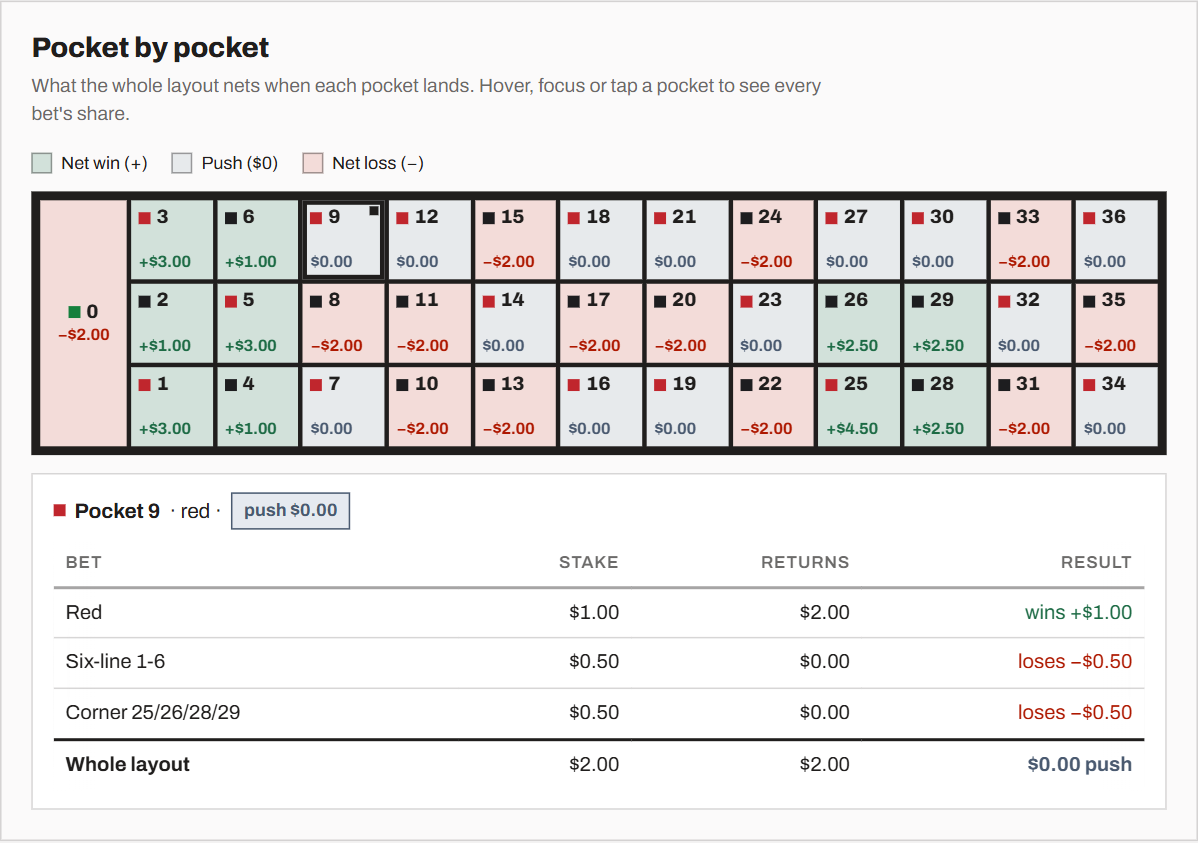
For the record, the layout's expected cost is about 5 cents a spin, 2.70% of what you stake — the same edge every bet on that wheel carries. It is real, but it is small, and it is not what ends a night. The run is.
How often the bad run arrives
In the lab, a losing spin is one that costs you money. A push is not a loss, so it breaks the run.
Over a 150-spin session with this layout, the exact chance of at least one run of six or more net losses in a row is 16.39%. About one session in six. Not a freak event — something a regular player should expect to meet.
Be clear about what that number is. It is the chance that the run shows up, not the chance that you go broke. Whether six losses in a row is an irritation or the end of the evening depends entirely on how you size the bets that follow — which is the question the rest of the lab answers. If the difference between a per-sequence and a per-session risk is new to you, sizing a session bankroll walks through it.
What a progression does to that run
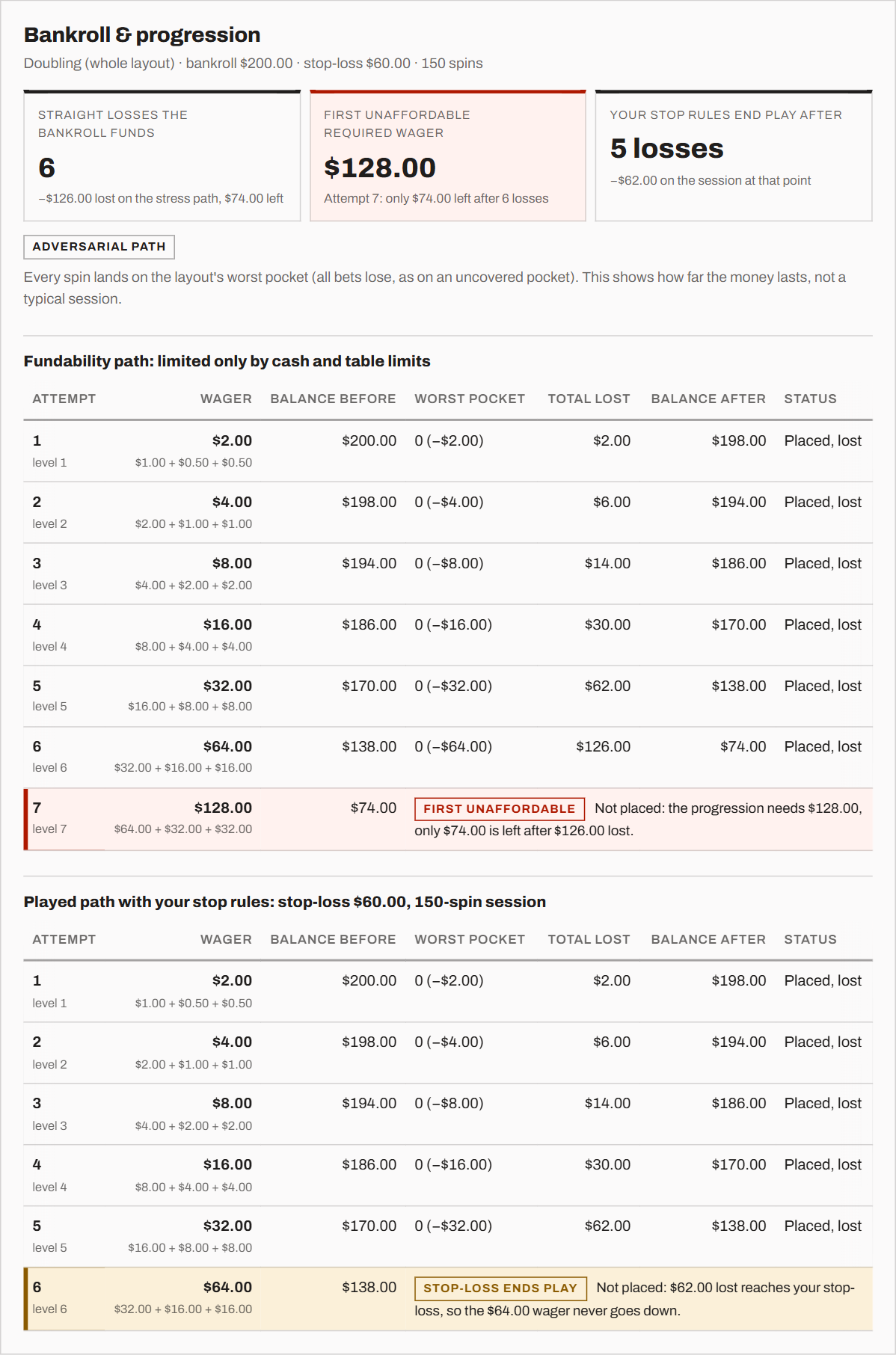
Here is where the run turns into a verdict. Start with $200 and double the whole layout after every losing spin.
The wagers go $2, $4, $8, $16, $32, $64. That is six losses and $126 gone. The seventh wager is $128, and the $74 you have left cannot fund it. That seventh bet is where this layout's nemesis bites: six losses in a row, and the progression asks for more than you have.
Add a $60 stop-loss and the picture changes. The session ends after the fifth straight loss, at -$62. That is a planned exit, not a forced one — the difference between leaving the table and being shown out of it.
Now the part most players never check. Say there is no stop, you are five losses deep and the sixth spin hits. Recovery, surely? Not necessarily:
- Hit black 2 and the six-line pays: +$32 on that spin, but the session is still -$30.
- Hit red 25 and red and the corner both pay: the session finishes +$82.
Same spin, same layout, same "hit". Which number lands matters as much as whether you hit at all. The lab lays that out pocket by pocket at every step of the ladder, so you know before the session which hits truly recover the run and which only soften it.
Find your own nemesis
The lab works in four tabs, in the order you would think it through:
- Build layout. Drop chips on any legal bet — straights, splits, streets, corners, six-lines, dozens, columns and the even-money bets — on a European single-zero or an American double-zero wheel.
- Analyze risk. Every pocket marked as a net win, push or loss; the exact chance of a long losing streak over your session; and the progression stress ladder for flat betting, doubling, D'Alembert, Fibonacci or a ladder of your own, applied to the whole layout or bet by bet. The nemesis finder names the failure mode that ends this layout and where it bites.
- Run sessions. An optional, seeded simulation of whole sessions in your browser, clearly labelled as an estimate so you never confuse it with the exact numbers.
- Risk report. Everything above on one printable page.
It is a losing-streak and bankroll calculator built around the layout you actually play, not a single even-money bet.
Take it with you
The full risk report is free. Print it or save it as a PDF, or download the numbers as JSON and CSV.
- Copy Strategy Link gives you a link that reopens your exact layout and settings, ready to edit.
- Challenge a Friend sends that layout with one question attached: can you lower the risk without raising the starting bankroll? Their version and yours sit side by side.
- Share via Email opens your own mail app with the link filled in. VIPER never sends anything for you.
Want to start from the layout in this article? Recreate this exact layout and every number above is waiting for you to change it.
Where VIPER comes in
The lab answers one question: what does this layout risk, on a fair wheel, over one session? It is the check worth running before anything else.
VIPER answers the next one: how does a complete strategy behave across real spin history, and how do you hold to your plan at the table?
- Describe it to the AI Wizard, and VIPER builds the strategy for you.
- Backtest it across thousands of real spins — and every purchase comes with a free million-spin dataset to test against. How to read a backtest covers what to look for.
- Let session discipline hold the line. Your stop-loss and take-profit fire at the numbers you chose while you were calm.
- AutoBet and Lightning Mode are there when you want them.
One factual line, because it matters: sizing changes the shape of your risk, not the house's cut. What it does decide is whether the bad run is something you sit through or something that ends you.
Decide the run you can sit through before you sit down. Then go and find out whether your layout can.
Only gamble with money you can afford to lose.
— The Professor