Ask anyone how they are doing at roulette and you will get an answer built out of stories. The night everything landed. The one that got away. A rough sense of being "about even, maybe a bit up."
Almost nobody is about even. They just do not have the ledger, and memory is a terrible accountant — it keeps the win in high definition and files the losses under bad luck, doesn't count.
The Bankroll Builder is the ledger. It watches every session, joins them up, and tells you the things a session-by-session view structurally cannot.
What it records
At the end of every session a snapshot is written and never altered: starting and ending balance, the net result, how long you played, rounds, bets, wins and losses, your session high and low, the worst drawdown inside that session, whether you reached your profit goal, whether your stop-loss was hit, and what each individual strategy contributed.
That last one is worth pausing on. Per-strategy contribution across sessions answers a question no single night can: which of the strategies you run is actually carrying you, and which one you keep playing because of one memorable evening months ago.
The numbers that only exist across sessions
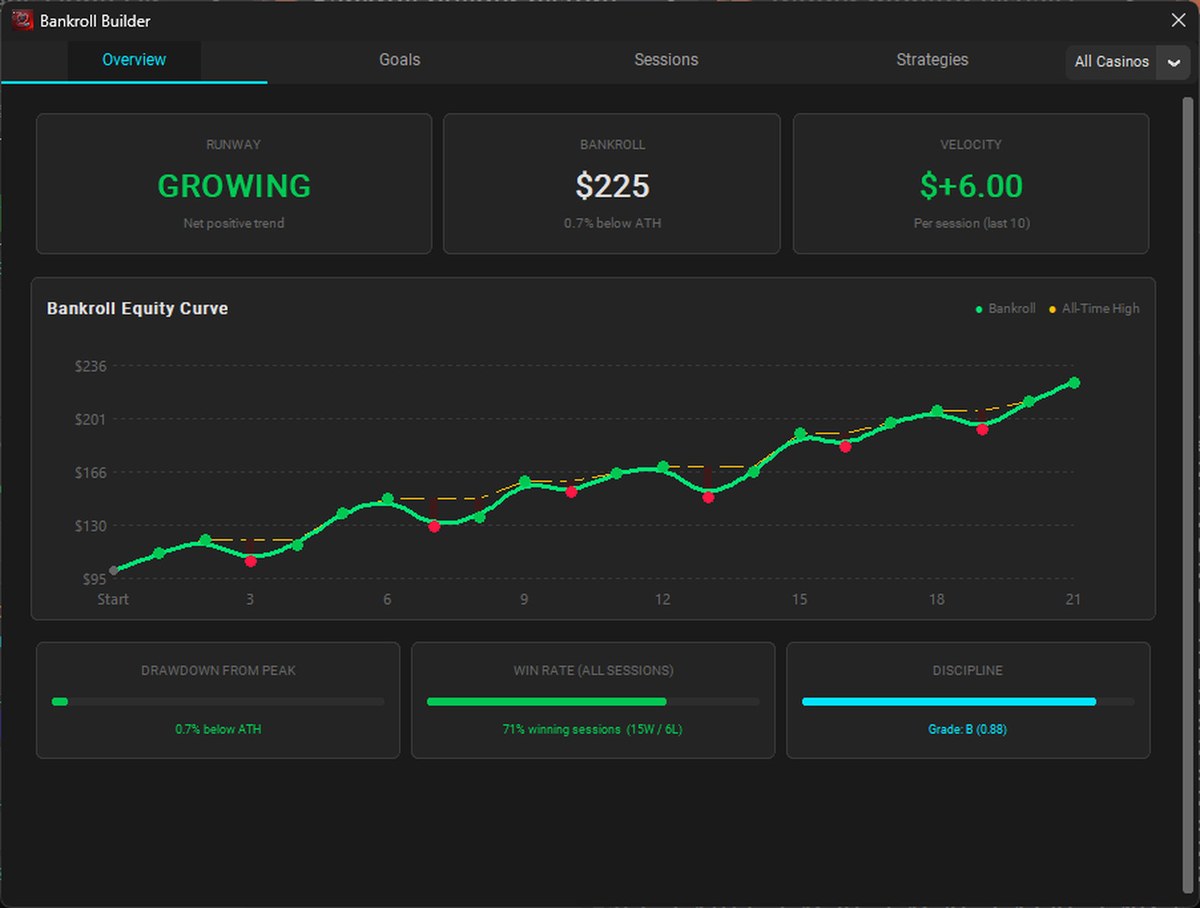
Runway. How many more sessions your bankroll sustains at the rate you have recently been losing. It needs three sessions before it will say anything, and if you are net positive over the window it simply reads GROWING. It is the least flattering and most useful number on the screen, because "I am down a bit" and "I have four sessions left" are the same fact told at two very different volumes.
Velocity. Your average result per session over the last ten. One night tells you nothing; ten tells you your actual trend.
The equity curve. Your bankroll across every session, with the all-time high marked. This is the picture your memory cannot produce, and the one that settles arguments — including the ones you have with yourself.
Drawdown from peak. How far below your best you are sitting right now. A player convinced they are "doing fine" and a player 40% off their peak are sometimes the same person.
The discipline grade, and why it ignores whether you won
This is the part we are proudest of, and the part that surprises people.
Every session gets a discipline score out of 1.00 and a letter grade. Five components, worth 0.2 each:
| Component | What earns the credit |
|---|---|
| Profit goal | You hit the target you set (or set none) |
| Stop-loss | You did not bust through the floor you set |
| Session length | Between 10 and 500 rounds — neither a twitch nor a marathon |
| Drawdown | Your worst dip stayed inside 30% of your starting balance |
| Balance adjustments | You did not keep topping up mid-session |
Read that list again and notice what is missing.
Nothing on it asks whether you won.
You can lose money and score an A. You can have a wonderful, profitable night — chasing wildly, three top-ups, straight through the stop-loss you set — and score a D. That is deliberate, and it is the single most important design decision in the feature.
Results are mostly luck over a short run. Your process is entirely yours. So the score measures the only thing you actually control, and it is the only number here that a good night cannot flatter.
That fifth component deserves a word on its own. Balance adjustments means topping up your money mid-session, and it is penalised because it is chasing wearing a respectable coat. The bankroll you brought was the decision. Anything you add after the session turns against you is not funding, it is the tilt talking.
Building Plans
Beyond tracking, you can set a plan: a series of tiers with names and thresholds, each carrying its own profit target and its own stop-loss.
This matters because the right session size at 200 units is not the right session size at 2,000, and almost nobody adjusts. Players either keep grinding tiny targets long after their bankroll has grown, or — far more often — keep playing the stakes that suited a big bankroll all the way down to a small one.
And when you cross a tier, that level can be locked as a floor. The trailing stop is then never permitted to fall below it. A milestone you have reached stays reached, which turns a plan from a wall chart into something the software actively defends.
Why any of this beats a spreadsheet
Because it is written automatically, at the end of every session, whether the session went well or not.
A spreadsheet gets filled in when you feel like filling it in. And you feel like filling it in after the good ones. Every honest player who has kept manual records has discovered the same thing: the losses are underrepresented — not through dishonesty, but because entering them is miserable and the day moves on.
The snapshot is written before you can decide the session did not count.
What it will not do
It will not tell you a strategy works. Twenty sessions is a small sample, and nothing at that size can separate luck from signal — that is what backtesting over the million-spin dataset is for.
What it tells you is the truth about your own play: your real trend, your real drawdown, how much runway is left, and whether you are keeping to the rules you set for yourself. On a short-session game where luck decides the night and process decides the year, that is the more useful mirror of the two.
Most players have never seen their own numbers. Almost everyone who does is surprised by them — and a fair few change how they play on the strength of it, which is rather the point.
— Team Viper